Addressing Mental Health on a Gap Year in Israel

Addressing Mental Health on a Gap Year in Israel

Graduating high school and beginning college is a period of enormous transition and change for any 18-year-old. Graduating high school and moving to a foreign country for a year with perfect strangers? That’s a catapult into adulthood, a thrust into independence and responsibility that requires careful planning to be a success.

After 65 years of running Young Judaea Year Course, we’ve realized that to provide an exceptional year of growth in Israel for a young adult, the mental health and wellbeing of our participants must be put at the forefront of program planning. Our learning has come to bear even more acutely with the generation coming of age during a global pandemic.

Building a sensitive, professional, and sustainable mental health support system on Year Course begins with looking into the needs of our participants. Every year there has been an increase in the number of participants who need mental health support while on the program. Some are already diagnosed and treated by professionals while others need support due to the challenges of learning how to live in a foreign country with individuals they have just met. It is our suspicion that isolation and lockdowns as a result of the COVID-19 pandemic have also contributed to this increase. Perhaps there has been a loss in the ability to enter unfamiliar situations with new people and connect with one another in an open and vulnerable way. This connection is essential for a successful gap year. In addition, we’ve seen a lack of resiliency so that any minor crisis, without a healthy coping mechanism, can quickly spiral out.

One major challenge our participants face is that the mental health support system they are familiar with including family, friends, and professionals is thousands of miles away. Our aim is to assist participants in building a new support system while spending a year in Israel that enables them to be happy and thrive in an environment that demands independence and responsibility.

We have taken three important steps to ensure the wellbeing of all Year Course participants:

Encouraging Openness
Training and Preparation
Partnering with Participants and Families

Encouraging Openness

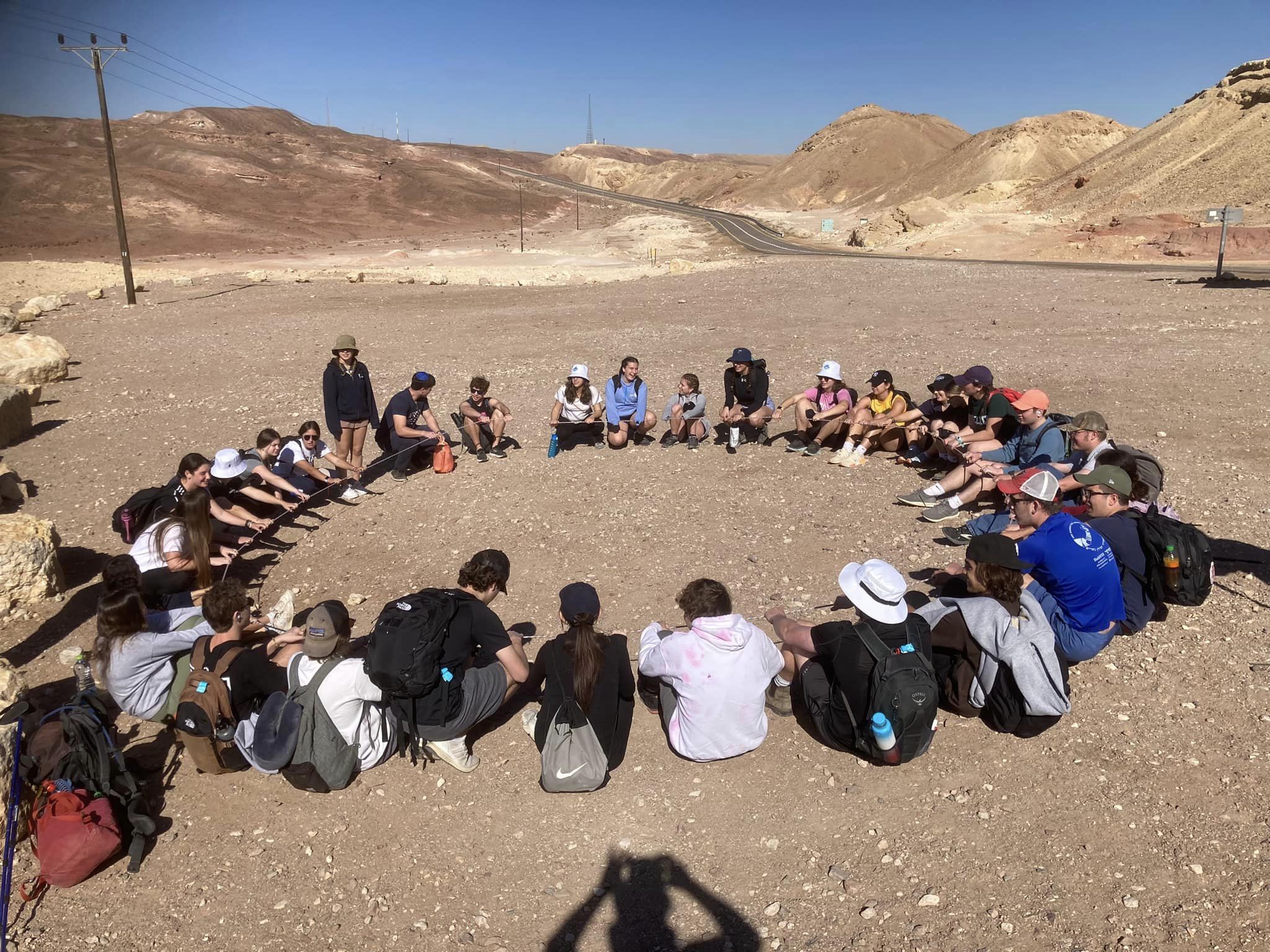
Imagine 200+ 18-year-olds from all over the world from diverse backgrounds, coming together to live, learn, and explore Israel together. This is the complex reality of a gap year in Israel. While the experience is beautiful and eye-opening for participants, this melding of worlds can be messy if not addressed properly.

The cornerstone of the Year Course mental health system is the understanding that the most dominant influence on the participants’ wellbeing is their ability to create meaningful open interactions with one another that will enhance their sense of belonging to the Year Course community. In other words – their ability to create meaningful and deep friendships while understanding healthy social boundaries. Meaningful relationships allow participants to feel comfortable expressing themselves to peers and staff when things aren’t going well, and to work through the complex feelings that arise when living far away from home. Forging these relationships is key to a happy and successful year and having this skill will have a positive effect on the rest of their lives.

The range of issues that arise range from your typical, “my friends go out without me,” to differences of opinions on the complexities of Israel, frustrations with the language and culture shock, or on occasion, dealing with true crises situations. Many people struggle to communicate how they feel and instead they prefer silent frustration. How can you forge deep bonds when you don’t know how to communicate your feelings?

Maintaining a safe space for everyone is a challenge our staff and participants deal with on a daily basis. Besides keeping people secure, a safe space also allows participants to speak openly and sincerely about the things that are bothering them. In that sense, the creation of a safe space is a key element when it comes to the mental well-being of Year Course participants. Open communication that enables staff to help and support the participants can only exist in a safe space.

Training and Preparation

Months prior to arrival on Year Course, we communicate with parents and mental health providers to understand the specific needs of our participants. Once the participants that need additional support are identified, we connect with them and their family support network upon arrival as well as recurringly throughout the program to help them nurture meaningful relationships in order to deal with complicated social situations.

Having the right professionals on board provides us with the right level of skills, support, and professionalism to ensure not only the wellbeing of our participants, but also of the staff.  We recently created a new position on the leadership team for someone with formal social work training and experience working with youth in distress. This position is embedded in the earliest stages of recruiting to help vet participants for their readiness to succeed in our program.

We can’t expect our counselors and unit heads to function as professional therapists, but we have found a way to provide them with tools, a mental health “first aid kit” so that they know how to react in the most challenging circumstances. These staff members are usually the first ones the participants will speak to during or directly after a mental health crisis and should be able to react appropriately to support the participant, triage the situation, and understand when to refer to an expert for further guidance.

Training covers areas such as signs and symptoms of common and less common diagnoses, initial intervention, dealing with drugs and alcohol related situations, mandatory reporting, preventing the recurrence of similar situations, and understanding when to refer to a professional. Mental first aid in crisis situations is aimed not only at the individual participant in need, but also at their peers, who may also be in distress. When supported, peers can then function as an important support mechanism for each other.

A crucial piece of our staff preparation is to form relationships with participants that are based on trust and a sense of security. Without a safe space for participants to express themselves and share their feelings, they are less likely to consult with staff on important issues. Staff accomplish this by being as accessible as possible and conducting non-judgmental and eye-level conversations with participants whenever possible. Additionally, the Year Course has professionals facilitate group conversations and trainings regarding various topics concerning both safety and acceptance including gender equality, sexual assault, and security. These conversations keep the dialogue open between staff and participants.

We train our staff to listen to the participants, try to understand their perspective, and empower them to have a positive and effective impact on their situation. For every situation, we expect and train our staff to be there for the participants as mediators, supporters, and moderators. We learned that in some acute crisis situations where there is a need to deal with Israeli authorities or medical emergency services where our staff become the mediators between mostly Hebrew speaking caretakers and the participants. This part of mental health support is crucial when it comes to dealing with the aftereffects of some crises.

Partnering with Participants and Families

The last important element of our mental health preparedness is to create a partnership with both participants and families. Sending your 18-year-old off to Israel for a year can feel like a leap of faith. Families must have the ability to trust the participants’ abilities to make good choices when it comes to their wellbeing.

We observe and understand how hard it is for some families to hand over independence to their children with even their everyday functions, let alone a year in Israel. We try to support families by maintaining a high level of communication between them and our staff as this helps them maintain some level of healthy control over their loved ones who are so far away. We also initiate regular emails to update families about the main features of the program and respond to messages within a reasonable amount of time. This level of communication is a key element in fostering a Year Course-family partnership that aims at supporting participants to flourish and grow while on the program.

By taking these three important steps to ensure the wellbeing of all Year Course participants: Encouraging OpennessTraining and Preparation, and Partnering with Participants and Parents, we are creating the conditions for our participants to experience growth and development in a healthy and supportive environmentWe are actively responding to the mental health and well-being needs of each Year Course participants, with the aim of imparting healthy coping mechanisms and resiliency for success on the program and that they can take into the rest of their lives.
How a year in Israel changed me

How a year in Israel changed me

By Mia Mikowski, Year Course 2022-2023

Before Year Course, I thrived in the world of academics. I was a straight A student with a love for STEM but I always struggled socially. In the beginning of the year, leaving formal education was a challenge for me. Some of you may remember the calculus problems I solved on my leg or the online class I took in my spare time. I did these things because I was terrified of spending a whole year without learning. In reality, I’ve learned invaluable lessons this year that academics could’ve never taught me.

One of the key lessons I learned was about friendship. While some of you came on this program with friends you’ve known since kindergarten, I, like many others of you, came in not really knowing anyone. As I met people, it was hard to imagine letting any of them into my life and trusting them the same way I did my sister or mom. Seven months later, I woke up to some especially difficult news. That morning, my MADA roommates put aside their plans of catching up on desperately needed sleep to be my emotional first responders. That day I understood how people call some of their friends their family.

There’s a lot of talk about the independence that we’ve gained this year, but the dependence we learned is just as important. Of course, there have also been many lighthearted moments I’ll miss- moments like karaoke, picnics on the beach, the bottom line is that I’ve never experienced a camaraderie quite like that of this past year.

This year also gave me the chance to fortify my relationship with Israel and revisit why I am a Zionist. Year Course’s open approach enabled us to explore Israel in whatever way felt meaningful to us. We got to visit so many beautiful sites and listen to countless inspiring speakers. We also got to learn firsthand about the various conflicts this country faces and uncover the deep societal divisions you don’t see from an outside perspective. We talked to people on all sides of the political spectrum- some whom I heavily disagreed with, but I think that especially this year, as Israeli society faces such a tumultuous period, all of us had to grapple with our personal relationships with Israel in a much more complex way.

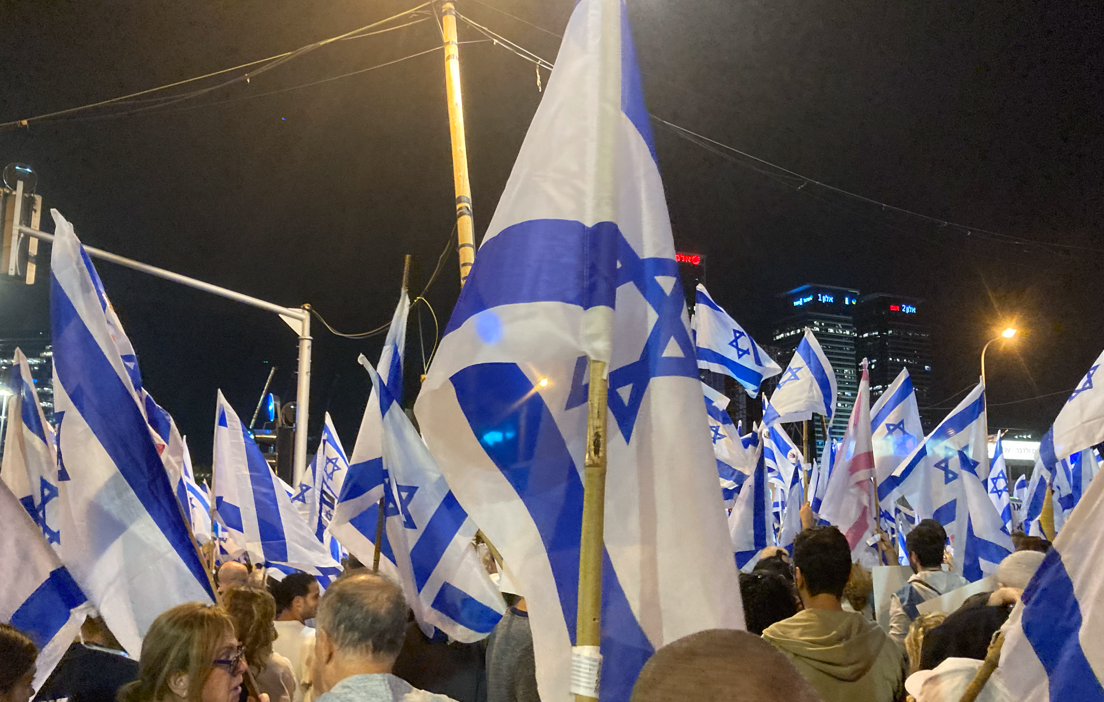
We got to live in Israel during one of its most trying times and see the best and worst of this Jewish democracy. While some of the notions of the judicial overhaul make me fear for the future of this country, getting to join the protests and see people’s vested interest in the state reaffirmed my love for the Israeli people. Of course, there are many issues within this country that I hope will change, but I’m still leaving this year with a deeper connection to Israel, a more complex understanding of its society, and a stronger Zionist identity.

The biggest lesson I learned this year was about letting go, having fun, and living life to the fullest. As I mentioned earlier, I came into this year very high strung, but the Year Course community has encouraged me to say yes to all types of opportunities- even those outside of my comfort zone. My confidence has skyrocketed here, and I’m able to embrace my authentic self, really all thanks to you guys.

Recently, I’ve begun studying for my college math placement test and I’ve found I’ve still got it for the most part- proving to me that once you learn something, it tends to stay with you. This is how I know the personal growth we’ve experienced on Year Course will stay with us for a lifetime.

L’chaim to all of us and to the incredible Year we’ve had! I can’t wait to hear about the things you all accomplish in the future.

Our Legacy

Our Legacy

Our Legacy

By Talia Bodner, Year Course 2022-2023

Judaean Aliyah Stories

Judaean Aliyah Stories

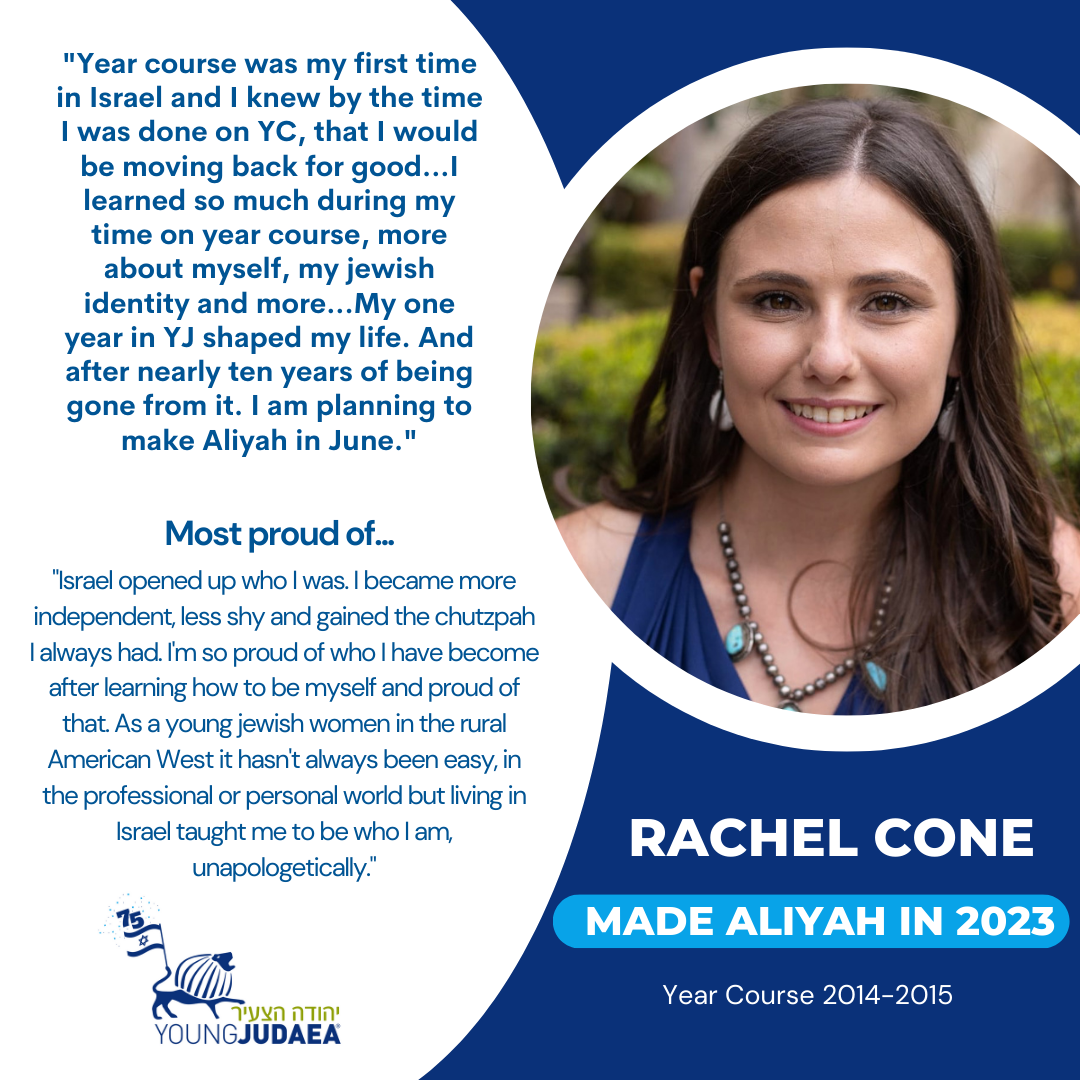
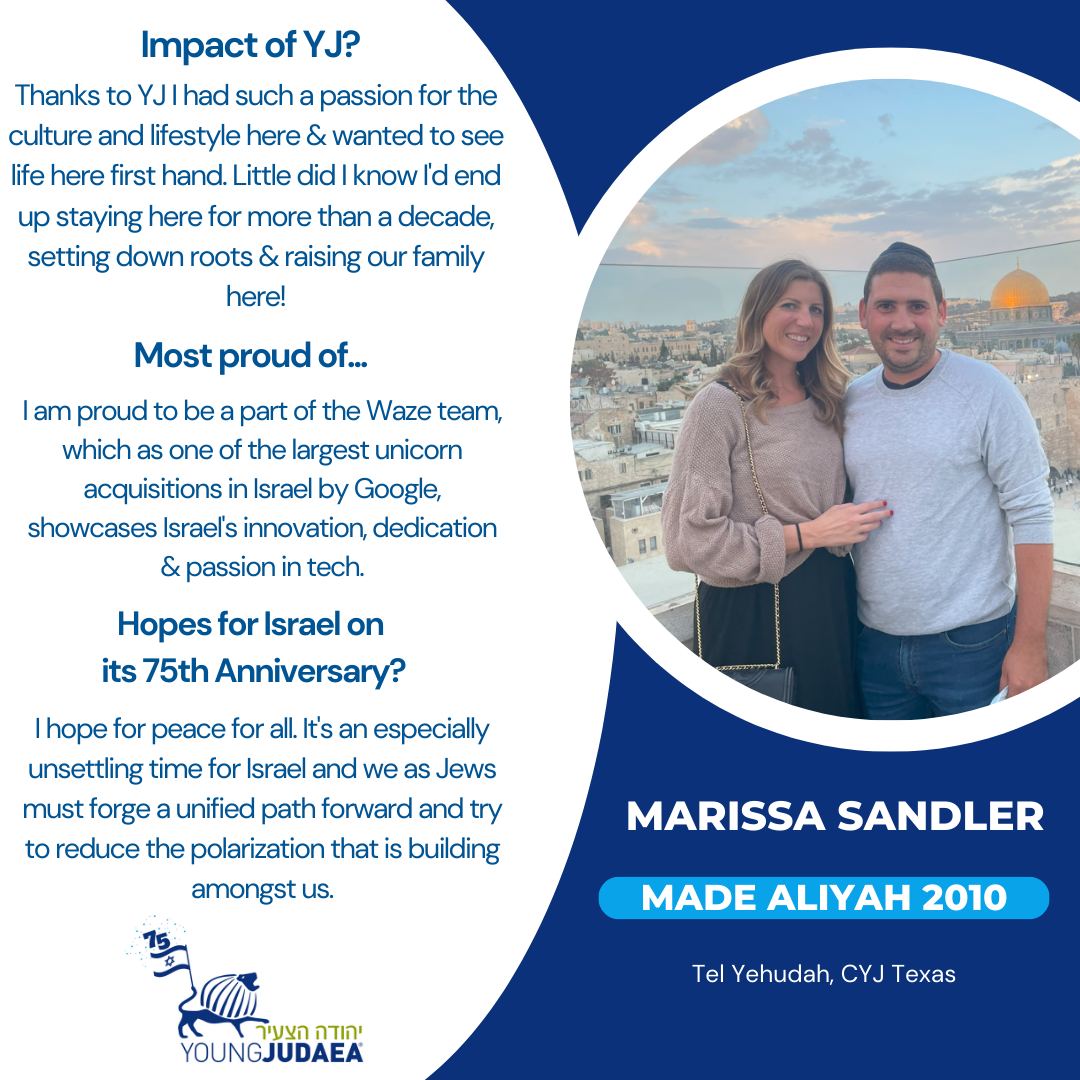
In Honor of Israel’s 75th Birthday, we are featuring Young Judaea alum who have made Israel their home!


Political Climate in Israel: A Conversation with Rabbi Adam Drucker

On February 26, 2023 70 Judaeans gathered together for Political Climate in Israel: A Conversation with Rabbi Adam Drucker, to virtually to discuss recent political events in Israel.

It was inspiring to see so many Judaeans gathered virtually together, continuing our movement’s legacy of learning and respectfully engaging in difficult conversations.

View a recording of the webinar below or click here to view on YouTube

During the webinar, Rabbi Drucker shared a supplemental presentation to further understand how Israel’s governmental system works:

Click here to view the presentation

YJ Statement on Israel

YJ Statement on Israel

As we are all following the unfolding events in Israel with much concern and solidarity, we feel that we can no longer sit on the sidelines as observers but that we must fully and unequivocally voice our concern and articulate our position in alignment with Young Judaea’s core values. 
Israel is our place, and now, more than ever, our Israeli chaverim must hear that we are standing along side them in solidarity and mutual concern.  

Judaean Turned Climate Activist

Judaean Turned Climate Activist

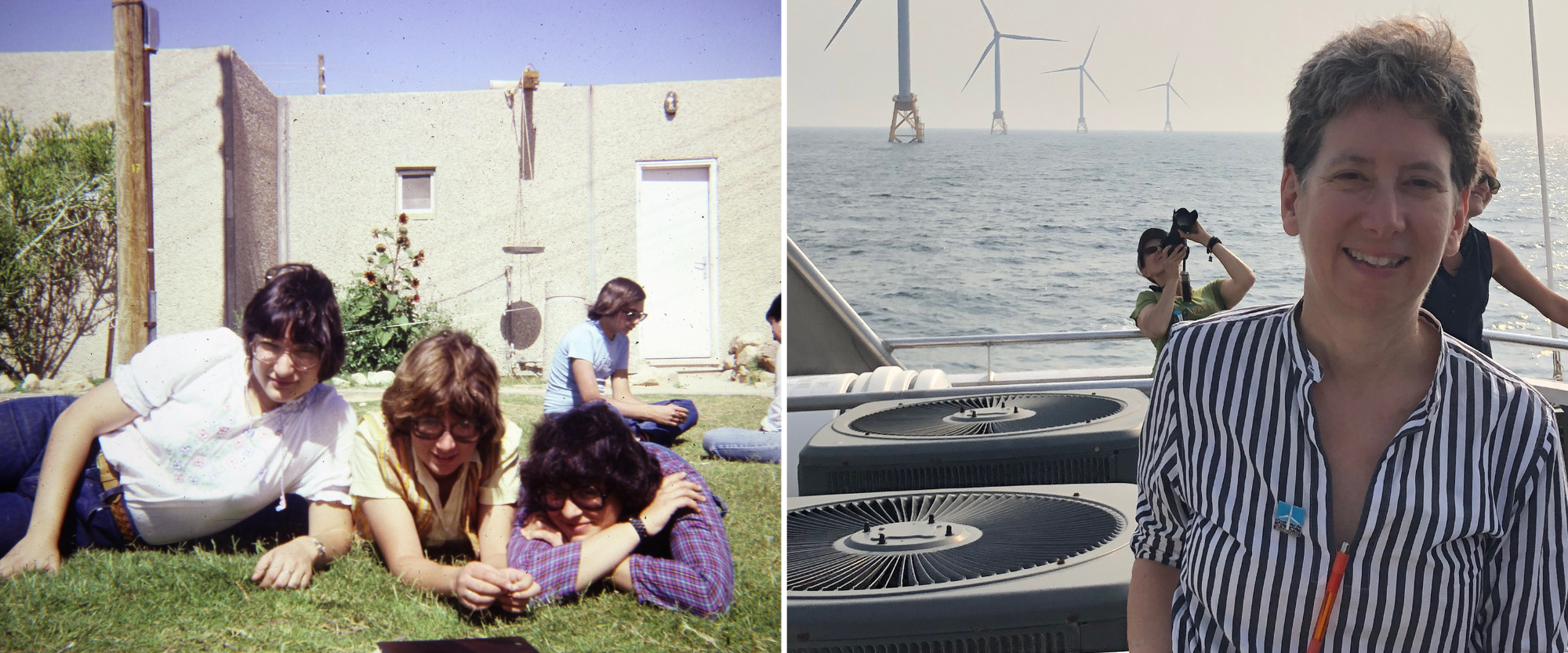
An interview with Mirele Goldsmith, founding member of the Jewish Earth Alliance


Tell is a bit about your background professionally and personally, including what Young Judaea programs you are an alumnus of?

I’m originally from Brookline, MA and joined Young Judaea as a freshman in high school. The region had decided to start a club in Brookline and I was recruited with a few other people to help. I went to Tel Yehudah for the Machon, and went to Israel on the Machon L’Madrichei Chutz La’Aretz (Year Course 1978). I also worked for hamagshimim.

I received my MSW in social work and spent a year doing field work in Tel Aviv. I’ve worked for a number of Jewish organizations including Hillel.

What inspired you to get involved in environmental causes?

In 1997 I went to Yosemite National Park for a wedding, and we went on the most popular day hike Vernal Falls. At the top of the mountain I saw something that changed my life: a solar compositing toilet. I found it to be a very interesting technology. There was a whole sign explaining how it worked and because of that toilet, I got involved in environmental issues.

After that I moved to New York and got involved with various environmental organizations and eventually went back to school to get my PHD in Environmental Psychology at City University of New York. My research was related to NYC water issues and making the water system more sustainable.  I started to get involved in grassroots activism to ban fracking in New York State.

At the time the Jewish environmental world was growing and I became involved with COEJL and Hazon and was part of the Jewish organization of the People’s Climate March in 2014.

It was at this time that became more interested in advocacy. Everything we were doing, it all depends on policy and what kind of policies are passed. When I was with Hazon’s Jewish Greening Fellowship they developed a group buying program for solar rooftop systems for Jewish Agencies and New York City had recently passed a law about community solar. We couldn’t have done this without that law.

How did the Jewish Earth Alliance get started?

After relocating to the D.C. area from New York, I found some like-minded people to start the Jewish Earth Alliance – a grassroots, all-volunteer network that calls on congress for climate action.  We try to make it easy for Jewish communities around the country to lobby the federal government and administration for climate solutions.

We recently had a webinar to prepare activists for the new congress and had 300 people attend! This event is leading up to a Tu BiShvat virtual lobby day we are organizing.


Uri Tsafon YJ convention – around 1977

How did Young Judaea lead you to where you are today?

I always tell everyone that my start as an organizer came from Young Judaea. I give a lot of credit to Young Judaea for my ability to be an organizer and to lead.

Young Judaea was the first time in my life when I found friends who cared about what I cared about. We did things with each other and you build relationships through experiences. I mean, going to Israel for a year, back in those days you didn’t call home. Your friends were everything.

I do attribute a bit of my interest in the environment to Young Judaea. I was not an outdoorsy person before I went to Israel, going to Israel we spent a lot of time outside, hiking and those things, learning about geology and the agriculture of Israel. Looking back on it, it did influence me.

Why are you specifically a Jewish climate activist?

3 reasons

  1. I was raised as a Jew and my beliefs and values come from Judaism, and I feel like I need to act on them. It’s not enough to just talk about protecting the earth. A lot of our holidays connect to nature and appreciation and awe for creation. We need to act on those values.

2. A lot of our holidays and rituals relate to nature and that makes it really meaningful for people to learn about environment and take action in the context of Jewish tradition. Lobbying on Tu BiShvat is something people can relate to.

3. We just need everyone. There is a slogan in the climate movement, “to change everything we need everyone” and, we need the Jews too. It’s much easier to organize people in groups and communities than to do it one by one.

What can young people do today to get involved in environmental causes and climate activism?

Fire Drill Friday protest on Capitol Hill with Jane Fonda in 2019

There are many ways that you can get involved but the main thing is to find a place where you feel comfortable and feel like you can make a difference. My work with Jewish Earth Alliance is about activating citizens, we are citizen lobbyists. You don’t have to be paid to be involved and make a difference.

Be Courageous. Another thing we learned from Young Judaea. Our motto was ‘Ani ve’ata neshaneh et haolam’, you and I will change the world. I wasn’t that courageous when I was younger, but over time I realized I can be. Fortunately in both America and Israel we can speak up, we can make  a difference, we should take advantage of that.

There are so many things we can do as citizens that seem very intimidating, but the main thing is to find like-minded people, join a group, and get involved. Because it’ all about how we can change the world together.

A Letter to my Son on the Shoa

A Letter to my Son on the Shoa


It is Friday, International Holocaust Remembrance Day and I write this from Rwanda on a Young Judaea alumni mission where 30 Judaeans are learning about and bearing witness to the atrocities of the Rwandan Genocide, and seeing and being inspired by the power of one person’s vision of tikun olam, Anne Heyman, z”l, Judaean and founder of the Agahozo Shalom Youth Village. Modeled after Yemin Orde, a youth Aliyah village in Israel, it was built as a school and community for those orphaned as a result of the Rwandan genocide. 

Today, the entire village is commemorating the Holocaust, but the irony is not lost on any of us that as we say “never again.” We now know that in the years following the Shoa, humanity continued to perpetuate atrocities through other genocides. The Rwandan Genocide was in 1994, but there were many others.

The village stands as a testament that each of us as individuals has the power to affect change and to fix this broken world by choosing one crack and dedicating ourselves to repairing it. Pete Davis taught us in his book, Dedicated, about long-haul heroes. Anne was a long-haul hero living her Judaean values through her actions. For the past few years, Young Judaea has brought 20–40 Year Coursers a year to live and volunteer in the village for a month and to be ignited by her vision. 

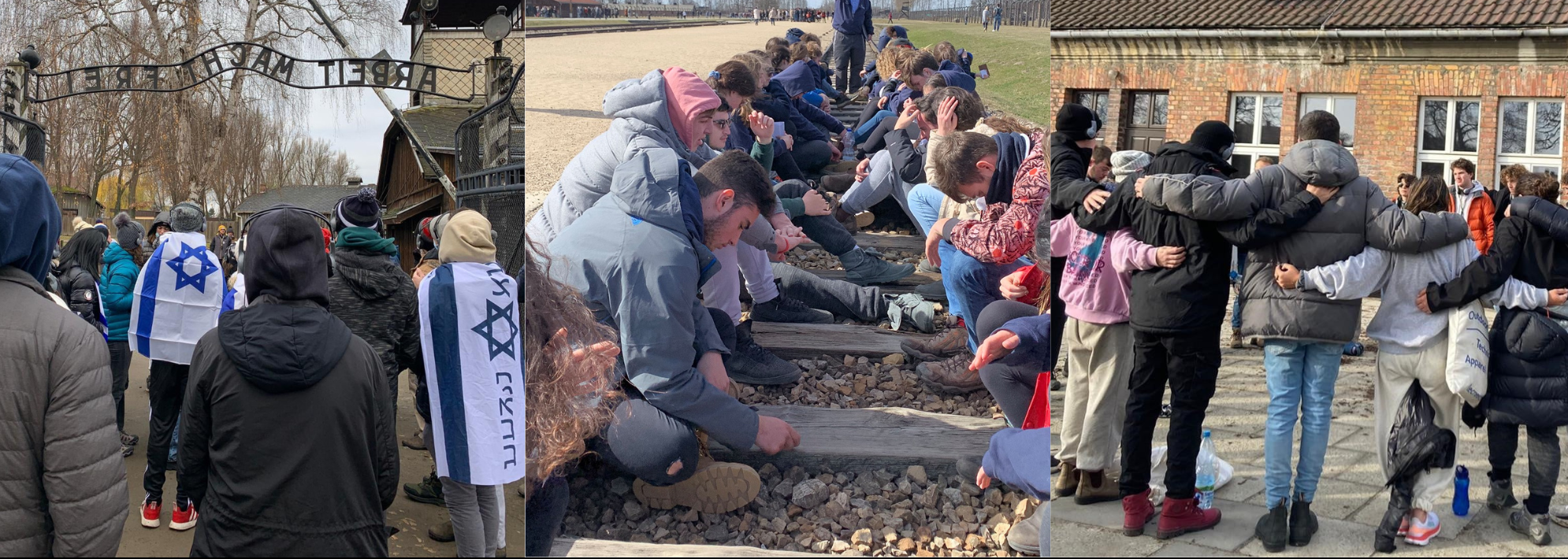
In the fall, my son and his peers traveled to Poland as part of Year Course and my husband Avi and I wrote him this letter in preparation. I am sharing it today because it feels even more relevant. 

Perhaps a more fitting imperative than “never forget” is “actively remember” so that we find some small way to act to ensure that it will never happen again…to anyone. 


Dear Son,

It feels like just yesterday we were holding you in our arms in an apartment in Manhattan. Before any of your siblings were born. And long before you became the man you are becoming. It is hard to believe that you, our bachor– first born, are off in Israel for your gap year. Where did the time go? Just yesterday we were telling you bedtime stories about our adventures in Israel and now you are there on your own coming-of-age pilgrimage in the Promised Land.

Amidst this exploration of Jewish life in the Jewish homeland, you are going to Poland to visit a place where many Jews lived, and to the death camps where many Jews died. It can sometimes be overwhelming to come face to face with the experience of evil. We want to give you permission to feel whatever it is that you are feeling, even if your instinct is to not let your guard down because you will likely be playing your usual role of caring for others who are breaking down. You should allow yourself to be in the moment and to process what you are seeing and how it informs your view of yourself, your community, and of humanity.
Aba and I didn’t fully understand the magnitude of 6 million Jews and 5 million additional human beings until we held you as a baby. In our hands was infinite potential. It was only when we understood our responsibility to one life in a real way that we could imagine the real cosmic pain of killing 11 million people. Each of those people also had mothers or fathers who held them. And as you consider the magnitude of such a genocide on humanity, remember that this targeted, systematic, and calculated near-annihilation of a specific group, namely our people, is what makes the Shoah particularly horrific.

In going to Poland, we hope that you come to contemplate a basic human flaw- that we all must contend with the evil in the world and the reality that we are either perpetrating it or not doing nearly enough to stop it. As we learned in Usual Suspects, “The greatest trick the devil ever pulled was convincing the world he did not exist.” We must be witness to the existence of evil to remind ourselves to do everything we can to fight it. 

But still, that is not the whole reason for going. As Jews- we do not go to fetishize death. While our people have been hunted- we are not prey. As Jews we celebrate life; despite or maybe because of all the horrors we have experienced in life we know how to laugh and get the most out of life. We go to Poland to remind ourselves what life is worth living for. The long history of Antisemitism is as old as the day is long.

Open your heart to the pain of others and open your mind to Jewish practice. Living a Jewish life is a whimsical act in being counter cultural. Open your hands to Jewish life and you will take flight, and nothing will get in your way. Our sending you on a pilgrimage to Poland is not because of our desire to imprison you in the shackles of Judaism’s victimhood, but to help you realize this precious tradition you have inherited. You are the keeper of the faith. The future is in your hands.

Let this unspeakable tragedy and manifestation of gross injustice further fuel your commitment to right the wrongs in this world to be a rodef tzedek – pursuer of justice. From the moment we held you in our hands, we realized the infinite potential you have. You will have many choices to make throughout your life and all will be an expression of who you are as an individual, as an inheritor of a deep legacy and tradition, and as a citizen of the world. We hope that your choices are personally meaningful, universally relevant, and distinctively Jewish.

Mami and Aba

זכור ZACHOR

National Convention 2023: A Reflection

National Convention 2023: A Reflection

By Mia Finestone

I had an amazing time at National Convention last weekend! It was an incredible opportunity for me to reconnect with friends from Young Judaea that live far away and learn about important topics of today.
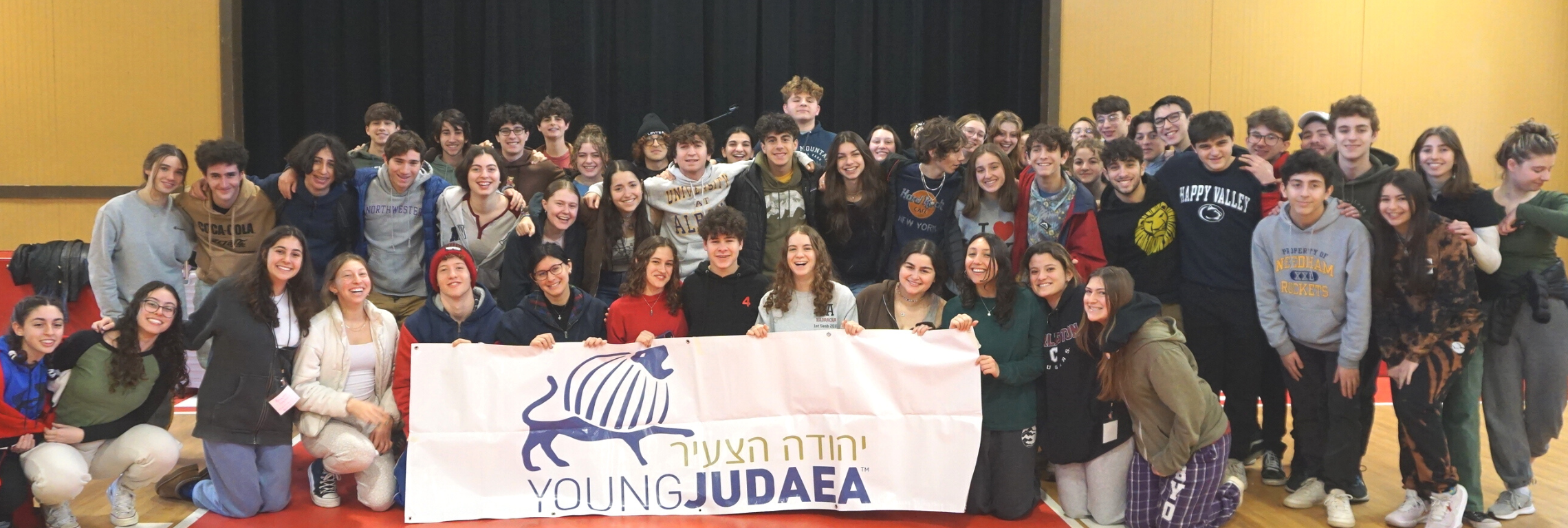
We participated in activities that focused on this year’s National Initiative, Women’s Rights, including discussions about reproductive rights, consent, the wage gap, powerful women leaders, and a service project where we packaged hygiene products for those in need. This was especially meaningful to me because this summer I was a part of the Women’s Rights Tikkun Group at Tel Yehudah that proposed this year’s initiative.

Along with activities on the initiative, we also learned about how Shabbat is celebrated around the world, by creating dishes from various Jewish cultures and comparing them to the ways we celebrate personally. In discussion groups, I was able to learn from my peers’ perspectives and share my own when we talked about topics such as Israel, Anti Semitism, and the roles they play in our lives today.

Throughout the whole weekend, I felt welcomed by my Young Judaea community and was never afraid to voice my opinions or share my own experiences. At our asepha (election), it was amazing to be a part of the election process for our future National Mazkirut, and it reminded me of the larger Young Judaea movement I am a part of. It was so cool to see my friends and peers be elected into positions of leadership for the movement I love so much. I had so much fun participating in our camp rituals of Shabbat, Havdalah, and rikkud. The moments I shared with my friends who I don’t often get to see, were so special to me, and reminded me of why I love going to camp.

10 Things You Don’t Know About Me – Hannah Wallick

10 Things You Don’t Know About Me – Hannah Wallick

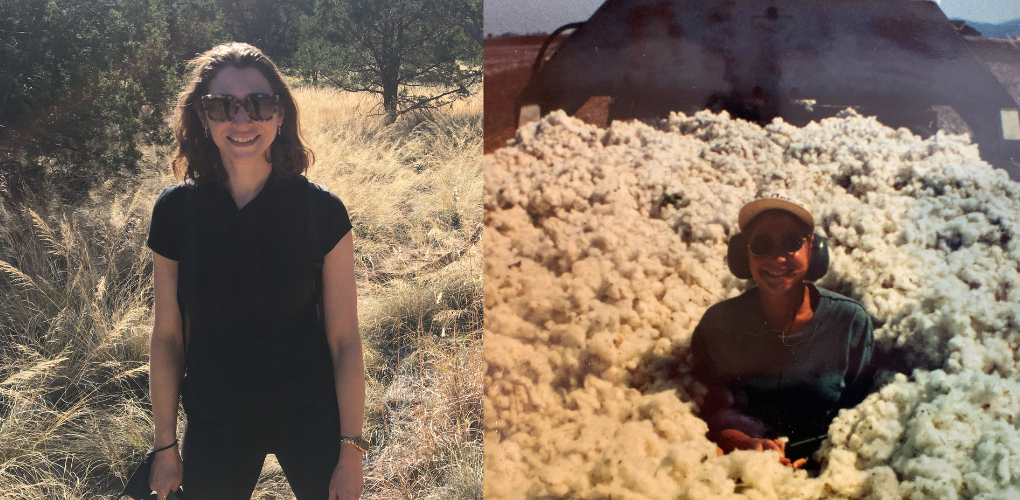
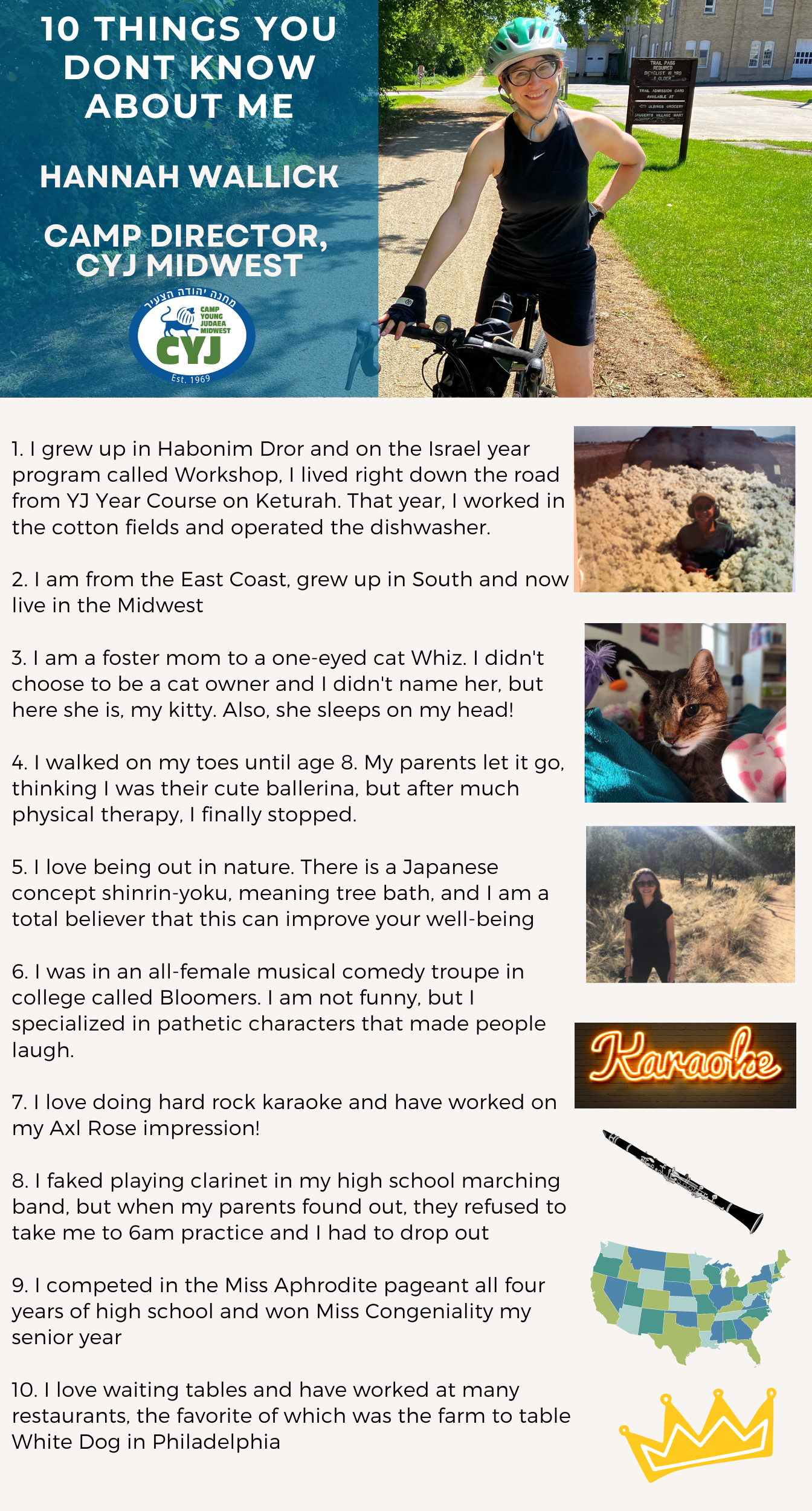
Get to know CYJ Midwest’s new Camp Director, Hannah Wallick!