From 1,000 Miles Away

From 1,000 Miles Away

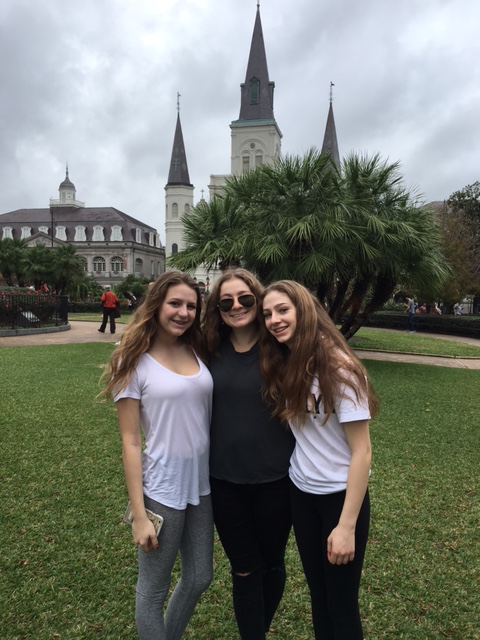
Fern with Ariella and Kaya (YJ Canada AWB Participants)

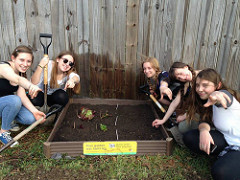
I don’t remember August 29th, 2005, as many people who live in the USA might have. I can assume that I was absorbing my last bit of summer, I was most likely up at my cottage just north of Toronto, I was reflecting on my past summer at camp, and I was probably dreading beginning a new school in a matter of weeks. I most likely watched the news, and saw footage of the storm that had wreaked havoc in New Orleans, but I doubt that my 12-year-old self would have been very intrigued by an event that was happening thousands of miles away from where I was. Now, I find myself thousands of miles away from where I was, intrigued by an event – that happened 10 years ago. Today my group and I had the pleasure of working with Green Light New Orleans to plant a garden for a mother, and a grandmother, whose home was destroyed during the storm and whose life had to be placed back together piece by piece. By creating this sustainable garden for her we put one more piece back in place. We also were given the opportunity to be welcomed into people’s homes in order to create a more energy efficient environment by changing the light bulbs in their homes. It was extremely humbling to hear their stories, and be welcomed into their homes, and to see how valuable and necessary it is to continue to support the people who were so affected by the storm. I can personally say that it was an experience I have never been given, one that I will never forget, and I look forward to what the rest of my week here brings.

~ Fern Kachuk is currently the program director of Canadian Young Judaea and grew up in the Movement. 

Messages from AWB Grads

Messages from AWB Grads

We reached out to some of our AWB graduates to send messages to those heading out this week for their own memorable experiences.  Read what they have to say:

adina
Adina (l) with Mika Itkin-Weinstein and a Recirculating Farms Volunteer

Hey yo AWB 2015! I hope you are all really excited for the next week because you’re about to participate in a program that used to be what I looked forward to all year. Seriously, it was the countdown on my MacBook each and every time. Have fun and make the most of it, but take it seriously and truly immerse yourself in what you’re doing. Don’t breeze past the volunteering part because you came to see your camp friends. Take it as an opportunity to accomplish great things and learn from those you meet with the company of these friends you cherish so much. This will enrich your experience and you will be happier because of it. Good luck and enjoy!

~ Adina Gitomer – AWB 2012, 2013, 2014. Year Course 2015-2016

jaocb
Jacob, a New Orleans resident and Friends Volunteering with Greenlight

Hi AWBers! As you all settle into your week of volunteering, I want you to ask yourselves why you’re here in the first place. Did your parents make you do it? Do you simply enjoy volunteering? Are you just doing it to meet up with your friends? Think about it well. Do you have an idea of why you’re here, yet? Good. Now forget that. Toss away any preconceived notions of why you are here and what you will be doing over the next week. Regardless of your motivations, I can guarantee you will all reach a similar end result: a strengthened sense of gratification for your fortune in life. The people you’ll meet, the stories you’ll hear, and the activities you’ll partake in all mean so much more than a simple motive for volunteering. Because while you’re just taking a week out of your winter break, this week will change the lives of the people you work with. Your job this week is not to just go through the motions of volunteering; rather, your job is to really ponder the stories you hear and to put yourselves in the shoes of those you help. It will make your experience a heck of a lot more meaningful. Enjoy your week to the fullest, and don’t forget to have fun!

~ Jacob Rogatinsky – AWB 2012, 2013 and 2014. Vanderbilt University

jordan
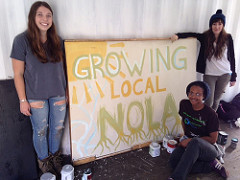
Jordan (2nd from l) with Noa Jett, Lucy Greenwald, Mika Itkin-Weinstein and Adina Gitomer plant a garden for a NOLA resident.

AWB NOLA is where I learned that I don’t necessarily have to go out of my way to make a difference. Literally being myself might have just impacted those less fortunate. Being able to dance like nobody is watching with little kids and singing Christmas carols in a homeless shelter not only made MY Christmas great but also put large smiles on the faces of the citizens of my soon-to-be home, New Orleans. I didn’t go on AWB to earn service hours; I went to do something meaningful during a break where I’d usually spend time inside watching TV or down in Florida.

~ Jordan Lawrence – AWB 2014. Tulane University

gabi
Gabi digs a hole!

AWB was the first time that I really got introduced to the world of volunteering outside my hometown. It was a program I was excited to go on seeing as my brother had gone on it a few years before me, and came home raving about all the cool stuff he did, and the people he met. My first time on AWB was in New Orleans. It was the first time I had ever visited the city, and throughout the week, I learned a lot about the importance of helping others, and how fortunate I, and all the other participants were, that we were able to spend our free time helping out others in a totally different environment that what we were used to. AWB was an incredible experience, and I got a lot out of it, and hope that you all will too.

~ Gabi Schwartz – AWB 2011 and 2012. Tulane University

Justice, Justice Shall You Pursue – Simon Klarfeld, Young Judaea Executive Director

Justice, Justice Shall You Pursue – Simon Klarfeld, Young Judaea Executive Director

“Justice, justice shall you pursue.”

One of the great teachings within the Jewish tradition lies in the biblical quote:

“Tzedek tzedek tirdof” or “Justice, justice shall you pursue.”  (Deuteronomy, 16:20)

The question we pose is: why is the word “tzedek” (justice) repeated here. The Rabbis teach us that there is no such thing as redundancy in the Torah, therefore any word or concept that is repeated, particularly as clearly as in this instance – has to be for a reason:

Are there two types of justice? A divine and a human? Does justice play out on two different scales? On the macro and the micro? Or two different arenas? The local and the global?

These are questions that your sons and daughters are currently grappling with  – through intellectual discussions, and hand-on experiences through which they are both helping community members in distress and reflecting on their own ability to change the world. Perhaps, after all that is how Young Judaea interprets the two types of tzedek:VTo act where we see injustice – to build, to protest, to support, to help – AND to learn through reflection of our own place in this world – to be better family members, neighbors, citizens, and human beings.

As you listen to your child’s stories of and reflections from AWB, share your own thoughts of tzedek with them; help bring about a shared, inter-generational commitment to change in the places in the world where we see injustice. If justice is to be realized, it will need to be pursued by ALL of us.

Simon Klarfeld

Priorities and Perspectives

Priorities and Perspectives

Last night, while watching an excerpt from a skid row documentary, a question was posed about homelessness – what can I do? The video listed off a bunch of possibilities, but ended with this idea- “invest in the collective consciousness that says compassion is essential.”

After one night with our whole group together, it feels like this is a group that understands what that means. Compassion towards the homeless is evident from the conversations I overheard during our peulah, where many different chanichim expressed a wide variety of emotions – guilt, shame, hope, confusion, discomfort, the list goes on. What was clear though, was that while our emotiaonal attitude towards the homeless is complex, we’re willing and ready to be challenged by the issue. 

Whether it be personal anecdotes about a homeless person throwing a bagel when they had asked for money, or sharing passionate views about systemic issues that plague the impoverished in this country, the chanichim have shown up ready to grapple with their “priorities” and “perspectives” – two words that came up a lot, in an attempt to do something to help the homeless. 

Our conversations about the homeless community in L.A. weren’t the first example of compassion though, that would have to be the hour plus of ice-breakers we did. In that time, compassion could be seen in how old friends rejoiced in being reunited, and in how new friendships have already started to to form.

Compassion may or may not be essential, but either way it’s something this group has plenty of.

~ Alex Zaremba

Alex is from Los Angeles, by way of Philadelphia Pennsyvania and is currently the Young Judaea Coordinator for Year Round Young Judaea in Los Angeles and a staff member at Tel Yehudah. He was on Year Course in 07-08.

Three Shots – Jane Dechtiar Young Judaea Shlicha

Three Shots – Jane Dechtiar Young Judaea Shlicha

ShowImage

Last week marked the Hebrew anniversary of the assassination of Prime Minister Yitzhak Rabin. It has been twenty years since one of the most horrible tragedies in the short history of the State of Israel.

1995 was a year that overflowed with tragic events. I was ten years old; and the feeling that I remember most was the fear in the streets.

There was a wave of terror in the summer of 1995: soldiers, adults and children killed almost every day. This was a first for us: we were not used to being afraid of riding buses.  We also had this innocent notion that characterized the country at that time, of “HaKol Yihyeh B’seder” – everything will be ok and peace is already here.

Rabin was the one who gave us the confidence that peace would come. It was he who fought so diligently that we should have this confidence – all of us, Arabs and Jews.

Yitzhak Rabin was like a father worrying about his children. Even when his children did not agree with him or know what they wanted, he gave them the feeling he knew where he was leading them. He was one of the last giants from that generation, the generation that knew how to take responsibility.

In the middle of all of the hate and terror, Yitzhak Rabin, along with Shimon Peres, advanced the peace process that led to the signing of the Oslo Accords at the end of that September – which meant recognition of the Palestinian people and their right to a state of their own within or next to the State of Israel. So Rabin gave control of most of the towns in the hills (Bethlehem, Ramallah, Tulkarem and others) to the Palestinian Authority, believing sincerely that this would bring peace.

Sentiments among Israelis were complicated. Rabin and Peres were harshly criticized by many for recognizing the Palestinian Authority and its right to sovereignty, and for giving support to the number one source of terror in Israel.  But Rabin believed that if we concede a little, we will gain much more.

Unfortunately, he was not able to prove himself. Or maybe he just was wrong.

On the 4th of November we heard the three most terrifying shots in the history of Israel – three shots that penetrated deep into every person, three shots that more or less destroyed the hopes for peace and opened the door to anger and hate that haunt us until today.

There are no words to describe what happened that night, no way to describe the feeling of shock. I remember the next day at school, everyone cried. The whole school cried not because a man was killed, but mainly because hope was killed.

It has taken us many years to heal our wounds as a united people, and we still have not come fully to terms with this trauma. Left and Right remain “enemies.” The memory of Yitzhak Rabin will always be engraved in our minds as the murder of peace – even if that peace was only imaginary.

Kibbutz Ketura

Kibbutz Ketura

What does it feel like to live on kibbutz?

Personally I really like it; you grow up in a very caring environment and are supported by a very good education. By age 13 you have a bar or bat mitzvah with all your relatives and by age 14 you get a job (I think that’s an amazing skill that not all kids have or get). You are always aware of the community around you.  School is on a different kibbutz, five minutes away by bus and is a school that is attended by all the surrounding community’s children, mostly from kibbutzim. On kibbutz we have a youth club house were we usually go after school to do our homework, relax, or anything at all.

But to answer the serious questions on everybody’s’ minds!

No, we do not have camels.

Yes, we have TV’s and IPods (even the new ones)

And yes, we do feel kind of isolated from the rest of the world.

~ Raziel Churgin attending camp Tel Yehudah in 2014 and is a second generation Judaean, his parents Sharon Benheim and Neil Churgin both grew up in Young Judaea before moving to Israel and Ketura. 

Born into Young Judaea – Nadav Cohen

Born into Young Judaea – Nadav Cohen

Hello, my name is Nadav Cohen and this is my Young Judaea story.  And it is a real Young Judaea story. It all started in January 1997 when my mom, Tamar Paul Cohen, was sent as a “Shlicha” (emissary) by the Jewish agency to Long Island, NY. She was working for UJA federation of New York and Young Judaea. During the summers my mom worked in the Young Judaea camps, first in 1997 she was the “merakezet” of Machane Hachsharah in Tel Yehudah and then in 1998 she worked as the Israeli “shlicha” at C amp Sprout Lake. While my mom worked in Sprout Lake she was pregnant with me, which is something that always reminds me how long and special my connection is to Young Judaea.

I was born in Plainview, Long Island, in September 1998.  When I was 4 months old, my family returned to Israel after staying in USA for two years. We moved to a house in Ness Ziona which is a small city not far from Tel Aviv.

 In 2002 my mom decided to work for CYJ Sprout Lake again, this time not from the Jewish Agency, but directly with camp.  She was an Omanut specialist. While my mom was working in Sprout Lake, my sister, brother and I enjoyed being a “Chanichim” (campers). Although I was only 4 years old and couldn’t connect to any of the campers because I didn’t know English at all, I still remember having fun as a “Gan” kid. Through 2007 my entire family attended Sprout Lake  for second session. In those years I was a Gan kid

In 2008, after going on a 6 months worldwide trip with my family, I decided to stop going to Sprout Lake. It was hard for me there as an Israeli and my mom stopped working in Sprout so I didn’t want to go. The different culture and the language made it hard for me to fully enjoy camp.

In 2012, after not going to camp for 4 years, I decided to go back to YJ. During the years I attended  other camps in Israel, However I always felt that need to go back to YJ, to go back to the place where my brother cried when he had to leave, the place where my sister calls “my second home”, the place where I grew up. So I went to camp alone for the first time as a “Bogrim” camper. I still remember how afraid I was but now I know it’s one of the best decisions I have ever made. From 2012 until this summer I have been going to YJ. I feel now that YJ is my home, YJ is me. Camp is amazing in all ways: I met a lot of amazing friends; I become connected to my Judaism and improved my English. When I tell my friends about camp they are jealous and they should be because camp YJ is the best and most educational experience I have ever had.

~Nadav Cohen

Nadav is in the 11th grade and lives in Tel Aviv. He hopes to continue to be involved in YJ while in Israel and can’t wait for his friends to get to Machon next summer.

Chicago YJ Update

Chicago YJ Update

chicago2

Chicago Young Judaea started off the year with a blast! Stepping up to the challenge of planning consistent year round events, nine teens met with Chicago’s YJ rep, Lee Gruen at the home of Kayla Lesch last Sunday for an afternoon of leadership training. Discussing what it means to be a leader and what they hoped to see happen in Chicago, the group laid out a schedule for the upcoming year including laser tag, social action events, and overnighters. After the leadership training, all Chicago Bogrim were invited for dinner and a campfire. The event had a great turn out, with almost twenty kids coming from all over the Chicago area and even Indiana. The evening was spent playing ice breaker games, catching up with friends, and of course, eating s’mores. With the music playing and kids sitting around the campfire roasting marshmallows, the atmosphere in the Lesch’s suburban backyard felt like it was right back at camp.

“I’m so excited to see real events happening in Chicago. And it was great to work with Lee, “ -Ben Hirsch, 15.

“I love seeing all my daughters camp friends together in our backyard,” -Debbie Lesch, mother of campers Kayla, Ben and Aryeh.

“I can’t wait for the rest of the year!” – Sam Honan, 16.

~Kayla Lesch

South Florida Update

South Florida Update

sf

Last month, Young Judaea South Florida had an amazing kick-off event! We had an outstanding number of kids in grades 4-7 show up. The kids were eager to bring YJ back and everyone was excited to see all their friends. We also had many new faces show up who shared that they loved the event and can’t wait for more. We started off the event with mingling and free play for the returning kids to see their friends again and the new kids to get to know everyone. We then split up into two groups -4th-5th graders and 6th-7th graders. The groups rotated between different stations. One station had a Jeopardy game all about Israel and Young Judaea. We even snuck in a Rikkud category which was extremely fun for everyone involved. We played a few seconds of the music and to get the question correct they had to get up and do some of the dance. The other station was different mixer games that involved a lot of laughing kids. For the third station everyone joined together and did a great round of Shira Shketa and Rikkud. Every single kid was dancing and singing just like they would be if they were at their respective junior camps. Overall it was a great event with an even better turnout! I am thrilled that each kid is excited to come to more events throughout the year and that the parents are even more thrilled that their kids get to experience Young Judaea like they did growing up! I can’t wait for future events that YJ South Florida will have in the coming year!

~Adina Tuchman

Click HERE for pictures of the event.

Adina is part of the leadership of South Florida Young Judaea.  She participated in Hadracha and Hamama at Camp Tel Yehudah this past summer.  Next summer, she will be in the MIT program at Camp Judaea.

I’ve Never Been a Fan of Yom HaZikaron – Yoav Levin

I’ve Never Been a Fan of Yom HaZikaron – Yoav Levin

yoav

I’ve never been a fan of Yom HaZikaron, Israel’s Memorial Day – a day on which masses of soldiers visit schools, cemeteries and houses of mourning, like swarms of uniforms and insignia coming to give their last respects to a fallen friend, father, brother or sister.

I have trouble with this day. Something in me doesn’t relate to sadness (although I have had friends who have fallen in action) or to collective memory (I’ve never seen myself as part of a collective), or to memory for that matter (even though I have served myself). But for some reason, every year I was drawn to the Memorial Day ceremony at school.  Why?  Maybe because I wanted to feel like I belonged, or like a hero because I showed up in uniform, or to comfort mourners because the tissue always peaked out of the pocket of my wrinkled uniform.

For many years I tried to understand why although I had no connection to this day, but was still drawn each Memorial Day to the same place.

One day, it hit me: What if it happened to me? What if this happened to my children? What would I do then?

On February 4, 1997, two Israeli Air Force helicopters collided in mid-air over the Hula Valley. One crashed in the moshav She’ar Yashuv, the other in an open field. 73 soldiers were killed in this disaster, among them soldiers of the Golani Brigade, Nachal, and two dogs in active service.

They were not killed by enemy fire, or by an explosive device while evacuating a building in Gaza, or by a rocket attack launched from one of the countries calling on Israel to be destroyed because we are living on their land – but from a mistake, a fatal mistake that took the lives of people’s children, brothers and friends.

Lieutenant Erez Stark, one of the soldiers killed in the tragedy, left behind a notebook with poems, songs and essays.  In one of these poems he wrote:

Nothing will hurt me, nothing,
Not a woman, nor a terrorist’s bullet, nothing,
Because that’s what I swore to my brother, my sister, my parents
And I cried by night and took care by day
Because I was afraid something would hurt my parents
And my father’s voice echoes in my head

After Erez was killed in the crash, the group Knessiat HaSechel (The Church of Reason) took the poem, put a melody to it, and released it for Memorial Day. The song was received very positively by Israelis and became a sort of national anthem for Yom HaZikaron. But more importantly, it encapsulated the pain that every Israeli feels on this day – and that some feel every day. That we promise to our parents that we will be ok, that we will come back healthy, victorious and not losers, with  our heads held high and not with our tails between our legs.  But what if we do not?  What if we are hit not by a terrorist’s bullet, but by something else?

In the second verse, Erez wrote:

If you’re standing above me now
I must not have kept my word
I’m sorry
I’m sorry
I’m sorry

Then it hit me: Maybe I come back each year to say that I am still here, like a checklist to verify that I still exist and I didn’t go anywhere, and even though some of my friends didn’t keep their promise and are no longer here, I still am, and I’m keeping my promises. And if I’m still here, I can change something so that it won’t happen again.

And maybe, just maybe, one day in Israel people won’t have to promise their parents, friends and siblings that they will return. They just will.

To listen to the song, click here

Yoav Levin is Young Judaea’s New England Shaliach. Read Yoav’s bio HERE. To read the article in Hebrew, click HERE.