Reflections from the Alumni Israel Volunteer Trip
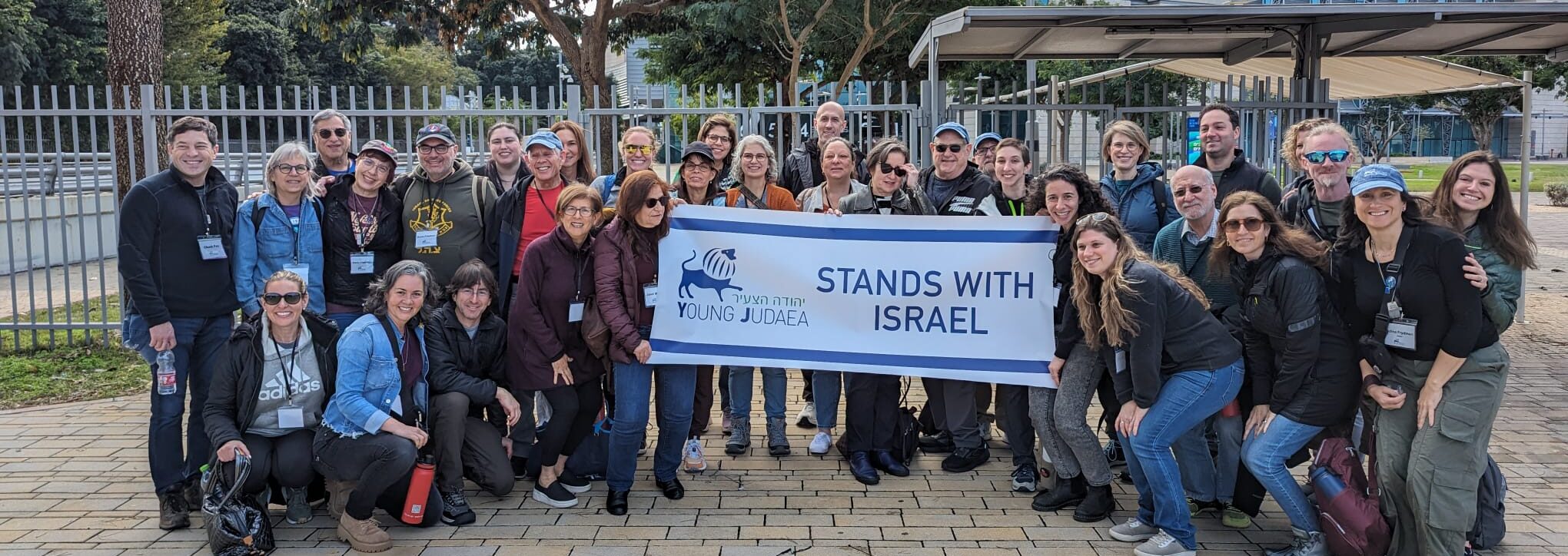
Several months following the October 7th attacks on Israel, 30 Young Judaea Alumni embarked on a transformative volunteer trip in Israel. The group spent time volunteering with various organizations, heard stories from survivors and heroes of the war, attended a panel of YJ Alum living in Israel, spent an evening with Year Course and had Shabbat at Kibbutz Ketura.
Below are excerpts from journals and reflections of the participants:
Talia Goldin
✈ How was it? I’m asked, as I think back to sharing a hotel with over 150 displaced families, who can’t go home because their communities have been destroyed.
🏡 How was it? I’m asked, as I recall our conversations with Nova Festival survivors, first responders, and kibbutzniks, who have been through hell and back – seeing atrocities nobody should ever have to witness, who lost loved ones violently in front of their eyes.
💔 How was it? I’m asked, as I think about the farm that supplies 80% of the country’s cucumbers, desperately appreciative we had come to volunteer, because they should have 35 workers and now they only have 2.
🧺 How was it? I’m asked, as I remember the faces of 130+ hostages, still in Hamas captivity, plastered on every wall, every building, every walkway.
🏢 How was it? I’m asked, as I think back to 10 days in my beloved country, a place whose people are crying and broken. Who are begging for the world to stand with them, but are being met by more hate.
Things will never be the same in Israel, but I will always be there for you, especially when you need me. To learn, to help, to hug, to listen. I stand with you forever and always.
💙 Am Yisrael Chai 💙
Rachel Plafker Esrig
Each resident that we met was quick to tell us their individual October 7th story. The entire country was, analogously, like the United States on September 12, 2001. Speaking slowly, with precise diction and obvious emotion, we witnessed Israelis in some yet unspecified stage of shock, but needing to share their experience as a step in their eventual healing. We had meals with many friends and acquaintances during our week. They had all lost count of the many shivas they had attended. And again, each one needed to share in order to process. They needed us to know about their trauma: their murdered or kidnapped relatives, their newfound lack of trust given that they had believed relations with Gazan had rested on something akin to mutual respect and personal interactions.
The other prevailing message was one of gratitude. By just stepping on Israeli soil, we had already helped. They could not believe that middle aged, “comfortable” Americans had taken time out of their daily lives and jobs to pick their weeds, irrigate fields, clean their childrens’ toys, but most of all: to listen. They felt seen, heard and understood, to the best of our insufficient abilities. We felt like human sponges, soaking all their sadness.
Ann Baker Ronn
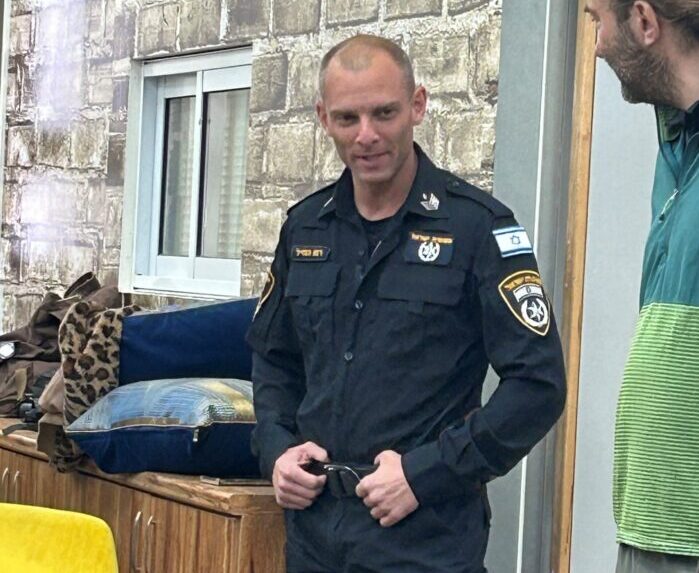
We visited the Bedouin village of Rahat and heard an unbelievable story of Bedouin Police Officer Ramo who saved over 200 lives at the Nova Music Festival. He arrived around 6 AM for his shift (a way to make extra money for his family) and soon after he arrived hundreds of rockets started. He and a colleague took a photo in front of the festival tent saying if they survived the photo would be a memory of their morning.
When the Hamas Terrorists arrived, he witnessed 26 other officers killed, leaving only 10 police officers to assist the 3500 attendees. His regular job is a homicide detective. His car was hit by a RPG so he searched for a car that had gas and keys in it. Once he located a car with keys and gas he drove frantically to gather young people into the car. He drove them to safety in nearby greenhouses.
Rabbi Neal I Borovitz
From the military cemetery on Mount Herzl we proceeded to Hadassah Hospital where we fulfilled the Mitzvah of Bikur Holit , visiting the sick, including a police officer who was wounded in Sderot on October 7th by the Hamas terrorists who invaded Israel. We also met with a Haddassah nurse who had just returned from active duty in Gaza. In addition to describing for us the emotional experience of delivering a Palestinian baby under fire in Gaza, he described for us the experience of rescuing wounded soldiers from battle in an “ open Humvee”. This nurse’s description of both saving soldiers and delivering a Palestinian child, while under fire in Gaza, coupled with the story I heard from a friend that night regarding her son in law’s experience in riding along as the” protection “ on one of these rescue vehicles, I have come to a new level of realization of how ingrained in the psyche and souls of Israelis is the Talmudic teaching of the ultimate value of every single human life, Jew or Non Jew.
Adina Frydman
There is no simple answer to the question, “how was it?” but we are each bringing back the stories of individuals, the stories that reveal the pain of the loss and the pride of the heroism, the agony of the waiting, and the joy that persists in everyday living. Weddings are still taking place, babies are still being born, and life goes on – it is the ultimate act of resistance. We have a responsibility to share their stories, to show them they are not alone and that we are with them. Everywhere we turned people thanked us, thanked us? Can you believe it? Having given the ultimate sacrifice, it was us who should be thanking them. But the truth is that they feel incredibly isolated, alone, and tired. If each of us took the time in the coming months to go to Israel and to do our small part by listening, hugging, and volunteering, it would help us collectively heal and find the inner strength to figure out what’s next and how we can move together towards that future. No one has the answers now but it is clear that there is no going back to where we were, and it is not yet clear where we need to go.
Chuck Fox
Vivian Genn-Pittman
I was nervous and also excited to go to Israel during this uncertain time.
Once in Israel, my heart was both broken and full. I was emotional, and grateful to be there.
I was inspired to be in Israel, to be in our beautiful country, our Jewish homeland, and to see people coming together to help, repair and move forward with strength.
In Israel, I laughed with family and friends, and cried at the devastating loss and ongoing challenges. I learned from soldiers within and close to my family about the unbelievable situations they face daily, and spoke with people who have lost loved ones or are waiting for loved ones to return home. I listened to one cousin decide which funeral to attend as she had two in one day, another explain the great measures the IDF takes to preserve all civilian life, and yet another explain how she and other psychologists are completely overwhelmed by the enormous and seemingly never-ending needs of a traumatized society.
Tracie Basch
A lot can be said of Israelis. I liken them to a sabra fruit – hard and prickly on the outside, but once you crack that outer skin, it is soft and sweet. The shell is there out of necessity. How else can over 130,000 people be displaced from their homes, moved into hotels and yet still smile and laugh?