Learning from Tyler’s Perseverence

Learning from Tyler’s Perseverence

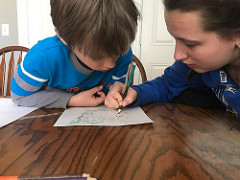
Rebecca and Tyler

I was assigned to the second house and met an 8 year old boy named Tyler.

The house mom at the Eagle Harbor Ranch spoke about how he enjoys the simple things in life, and is really intellectual. During lunch, I was sitting with him and he started to open up to me about his life. He brought a picture frame of him, his mom, his dad, and Santa Claus from 2011. He pointed out who everyone in the picture was, and made a point to say that he really misses his mom.

He talked to me while we were playing about simple things like school and his likes and dislikes. Although he was so young, I could tell he was wise beyond his years. He would ask questions about my experiences to learn more about the places and things I was talking about. He would randomly open up to me about specific experiences at Eagle Harbor Ranch. He mentioned that he liked that they had Minecraft, but didn’t like that the other kids were mean. He believed that he didn’t live at the Ranch; I felt heartbroken that he was uncomfortable and was unhappy with the way he was living and his situation.

When I left, he gave me a hug and said “I love you” and wished that I would come back soon. It was hard to tell him that I was simply there for the day and that I was not another staff member at the organization.

Later in the day, I was told that that his parents are divorced; his dad is out of the picture, and his mom was stabbed a few weeks ago. I was told that her condition wasn’t stable and that it does not seem to be getting better.

It was a very eye opening experience and it wasn’t easy for me to sort through my emotions. On the one hand I was heartbroken by the difficulties that Tyler faced and that he was unhappy with his situation, but on the other hand I was was blown away by Tyler’s perseverance and his willingness to adjust and adapt to the situation.

One Lost Boy

One Lost Boy

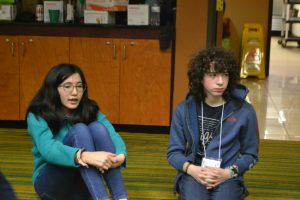
Nava (l) discusses her day with her group

Today we were volunteering at a carnival to celebrate Christmas for those who may not have a home to celebrate it in or had the materials to celebrate it as richly as we often do. During the several hours that we were working in the carnival, I felt bad not giving them an even better experience than they already were having, because some of the kids coming to play at the baseball station I helped run were frustrated because we were outdoors and the wind was not helping the air current flowing out of the cone help the ball stay in the air.

During carnival, I met a young boy maybe 5, 6 years old who was by himself and participating in the Spongebob Bouncehouse as well as the baseball station I was running, during the second time he was visiting my station he said he was lost and looking for someone. I asked him what she looked like, and of course being young he was, was bad at remembering what she looked like, he also wasn’t acting like the fact that he was looking for her was urgent so I didn’t know what to do in the situation. So I sent him back to the bounce house to play some more and keeping an eye on him all the same to see if someone was coming for him. At the end of the carnival I saw what looked like an older sibling call out his name and the boy came sliding down to join him to go what I assumed to be home. I had never felt quite as relieved as I did, but I was glad that I remembered that an adult always says “If you are lost, stay where you are and we’ll find you” because the boy stayed in that general vicinity for the duration of his stay and I believe the fact that he didn’t wander off made sure that he was easy to find. However I do wish that I had been a little more proactive and had told someone with more power than me that he might have been lost, maybe then I would not have been so freaked out when I should have been focused on helping more kids have a very Merry Christmas.

~ Nava Sherman; 9th grade, Queens, New York

My First Job in Sports

My First Job in Sports

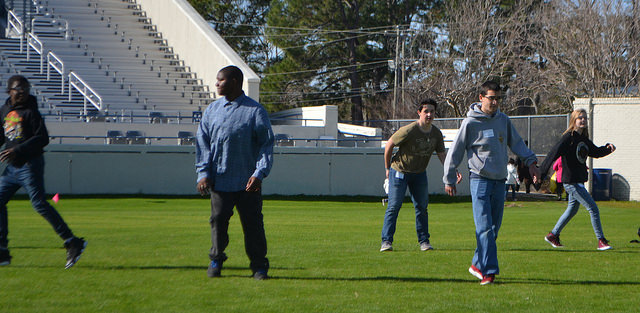
Michael (3rd from l) on the field

Today, we went to the Citadel Football stadium where an organization called “Without Walls Ministry hosted an event for disadvanted children and families from the local community. There, they distributed groceries, gave gifts to kids, and offered a variety of activities and services including haircuts, a carnival for the children and sports activities. They were also able to distribute over 200 bicycles to children. It really brought together a community and gave people something to celebrate for Christmas.

My “job” was to play football. Doesn’t sound like a job really, nor did it feel like one. It really fascinated me how a simple game of football could actually “make” a kid’s Christmas. We had about 30 kidssplit between two teams. Even though I had never met these kids or visited Charleston as a city, I felt instantly accepted as a part of their community. There was this little boy named “D” that I really liked. We would so special plays I set up for him so he could get the ball. No matter if he missed the catch or got tackled, he always got up with a smile on his face, ready for the next play. the level of joy I felt making that kid’s Christmas is something I will never forget.

~ Michael Lewinbuk; 9th grade, Houston, Texas

Staff Reflection: Stephanie Blitzer

Staff Reflection: Stephanie Blitzer

After an early start this morning, I watched as our teens pushed past the exhaustion and cold weather to reach out to and engage with children who attended Without Walls’ “Happy Birthday Jesus” Christmas party. Whether it was tossing a football, helping children out of a deflating balloon house, or picking up trash; our teens were always “on” and ready to give the kids a Christmas to remember. I watched as our teens thought up and initiated activities with children regardless of their age, ability or gender. It was inspiring to watch them bring smiles and warmth to these children’s day. And it wasn’t just the children and their families that AWB participants touched, but volunteers and leaders of the event were also touched by the commitment of our teens to help others. They were thankful for the extra hands, the young faces and the high energy spirit that our teens brought to the different stations at the event.

As a current staff member and a past participant of AWB, I am inspired to have the opportunity to hear about how our teens choose to engage with and act upon the issues of racism and social injustices. It is exciting for me to hear how the conversations between AWB participants are similar to the conversations I participated in while in New Orleans. During my group’s sikkum yom (reflection discussion of the day), I felt a sense of pride hearing my group speak passionately and eloquently about moments during the day when they struggled with and/or felt uncomfortable by racially charged comments and actions made by other volunteers, and when they helped bring smiles and happiness to a child and their family. Listening to them speak about the moments that stuck out to them reminded me of moments when I was a participant sitting with my group reflecting on the day. I recall fond memories of bonding with my peers and diving into deep discussions surrounding race, injustices, and education. The opportunity to listen to AWB participants discussions tonight, and for the rest of week makes me feel refreshed, energized and ready to see what this week has to offer.

~ Stephanie Blitzer: recent graduate, American University – New Jersey

Still Many Gaps in Giving

Still Many Gaps in Giving

Today was Christmas, we worked with the organization Without Walls to put on their annual Christmas party, or “Birthday Party For Jesus”, for both families and individuals living in poverty. I worked giving out presents to kids as young as six months old to as old as 16 years old. After sorting the gifts that members of various communities and churches had donated into groupings by gender and age, we distributed them to hundreds of kids. Often times we wouldn’t have presents for kids on the older side of the spectrum, which was disheartening but ultimately showed that even in an organization as well run as this one, there are still many gaps in what is needed. Because of this, I ended up having some uncomfortable interactions with kids more my age, however the reactions I got by some of the little kids made the unpleasant interactions obsolete. I remember randomly picking up a doll for a young five year old girl and watching her face light up as she saw it was an Elsa doll. This reaction was repeated after I handed another young girl a Barbie doll and her eyes became wide and mouth gaped open. It truly felt as though I had completely made her day and shed a child like innocence on the entire process.

~ Rachel Lock; 10th grade, Manhattan, New York

Welcome to the AWB Daily Update

Welcome to the AWB Daily Update

At approximately 7:15pm tonight, all of the AWB teens had arrived in Charleston. After resting up, playing games and informally getting to know one another, the action began.

This year, more than ever, the teens came on to AWB understanding that the trip is so much more than the physical work they will be doing. Our goal is for the teens to walk away from this program not only understanding what needs a city like Charleston has, but what can it teach us about the world and what it needs from us.

Our Mazkirut (teen leadership) chose this city after some thoughtful debate about the purpose of Alternative Winter Break being about issues as well as the work we do. To this end, they chose to focus on the issue of racial division and racial justice.

Each day, we will be sending you this newsletter. While this evening’s update is written primarily by staff, starting tomorrow, the teens will do the writing. You’ll also get to follow their experiences through photographs and videos.

The Young Judaea anthem is the Arik Einstein song “Ani V’ata Neshane et HaOlam” – you and I will change the world. Alternative Winter Break is one of the experience that we give our teens to help them see that this is possible.

Living Like a Local in Jerusalem

Living Like a Local in Jerusalem

Traveling allows you to experience and become a part of a different culture

The Giving Circle – Year Course Kedma 2017

The Giving Circle – Year Course Kedma 2017

Giving Circle is the concept of a group of philanthropists coming together and creating a pool of money, which is later given as a grant to an individual or organization.

First, we decided what our causes would be — Children, Poverty, Education, and Science.

We then had applicants apply to our grant, and we set up meetings with those we saw fit.

Having this experience truly changed me in multiple ways. My family has always been very big on Philanthropy, but since I wasn’t in charge of any money I was rarely involved in the decision making. Now that I have had this opportunity, I have a bigger grasp on what Non-Profit organizations are and how I can involve myself with them.

Another thing I did not know anything about — Overhead. Overhead is basically the expenses that go towards things like electricity, water bills, paying for staff, and so on. Some people say that they would rather their money go to something more hands on and visible, but I believe that whatever cause the organization needs the money for is a just reason and should be granted said money.

We did a few visits, one to a farm a little north, and one to an organization in southern tel aviv that works with marginalized communities that have immigrated to Israel. We also visited a robotics class that basically has the same principles as the farm, which is working with underprivileged kids after they are done with school for the day.

I specifically enjoyed the visit with the farm, because the leader gave us an in depth presentation on the organization, their statistics, their budget, what they need the money for, and much more!

We also were visited by an organization called IMAGINE that works with children on the autistic spectrum. This organization helps kids from highly functioning autism to living in hospitals how to make music with different technological gadgets. I loved learning about them, seeing what they do, and I appreciated the way they presented to us.

Giving Circle is an amazing opportunity for Year Course participants and the community of Israel. I truly believe that the giving circle is a great addition to Israeli society and I am so proud to be apart of it. The concept itself is wonderful, and ours specifically has been great. I have learned so much about myself and the community.

In regards to our reading of To Heal A Fractured World, Chapter 3 states that those who count as impoverished hold certain circumstances. One example is someone who only has 200 zuzim or less. The chapter says that God takes care of the poor, because they are equal to rich people other than their status. God rewards those who help the poor. I believe that this is important knowledge to know, although I don’t necesarily agree about the God part. My belief in God is not the traiditional jewish belief, although besides that, I think it is more important to believe in the idea of a person helping a person rather than a higher force “looking over” those who need it. When do we see poor people getting help? From other people, not an unseen entity. But some could argue that God is who sent the person to help, so it really just depends on your beliefs.

Chapter 6 explains that housing is a basic human right according to Judaism, and that a society that does not take that value into consideration is corrupt and unjust. Those who are fortunate  have an obligation to help those who are not, and in order to have a well functioning community everyone within it must have a stable living situation. I agree with this immensely. In my opinion, it is very important for our community to support each other and live as one rather than unequal, as if some are better than others. No one is better than anyone else, some people just have better fortune in life. As stated in the book, “adequate housing, according to these texts, must not only provide shelter, but must also allow for a dignified life.” The text also states that “by saying that housing is a basic human need, included in the category of tzedakah, we simultaneously say that individuals and the society as a whole are obligated to provide housing to those who need it.” I believe this quote defines the entire point of this chapter.

An article on “thelifeyoucansave.org” states “The scale of poverty is immense and we seem powerless to stop it. Such despair is understandable, but the facts tell a very different story. While poverty is indeed extreme and widespread, it is easy to forget just how many people there are in the developed world, and how powerful our pocket change can become when pooled together.”  

Reading this confirms how I feel about this issue, and as shown in the video you can see that while many care, many neglect to actually give. I believe this is because people feel they won’t change anything. But every penny counts.

I joined Giving Circle because of the principles I just stated. In all honesty, taking this class has opened my eyes to possibly majoring in Non-Profit administration in college. The organizations we met with were all so interesting and made me really glad to know they exist and are working so diligently to better the world. I believe that us, as Jews, and especially as fortunate ones, are obligated to help America and Israel as much as possible. Love is truly the only thing that helps this world go around; and this is a huge way to show it. Everyone is just trying to live life, and those who aren’t as lucky as others deserve the help they can get!

https://www.thelifeyoucansave.org/learn-more/why-donate

https://www.justgiving.com/piliontrust

https://www.youtube.com/watch?v=IvWjhp62zhM

 -Marley Lerner, Year Course 2017-2018

Young Judaea’s Midwest Winter Convention – November 30th – December 3rd 2017

Young Judaea’s Midwest Winter Convention – November 30th – December 3rd 2017

Lead by the Midwest Mazkirut (teen board), Maya Garfinkel, Ben Hirsch, Charlie Met, Melanie Silver, Tziona Chernoff, Max Aizenstein and Daryn Smith, 39 teenagers from the Midwest including 3 “field trippers” from Texas, NJ and Long Island, gathered together to have fun with their camp friends, make new memories, and learn more about others and themselves. We talked about communication and connection – the different ways language can be understood and influenced, and the affect it can have on a person. The weekend was full of fun, friends, and education. We had 4 peulot (programs) that were about different aspects of theme, communication and connection, that took place in small discussion groups. We also had SNF, Saturday Night Fun, which was a sports themed party complete with a photobooth, sack races, and more!

Check out all of the pics HERE

Thanks to the Midwest Senior Advisor Rebecca Schwab and to our weekend “Madrichim” (counselors) Adina Lipschultz, Levi Applebaum, Robin Silver, Jessica Morris, Amos Pomp and special guest, National Senior advisor, Nathan Rubinger.

Convention Quotes:

“I felt like the weekend was one big success. Being on the Mazkirut (teen board) for the first time was both stressful and fun. I had an amazing experience creating convention, and then when I got there I got to see everyone enjoying it. As someone who hasn’t gone to camp with all of the kids in attendance, it was really cool to meet and bond with the underclassmen who were newer to convention experience at the beginning of the weekend, but came out of it as pros. I was so happy to see that everyone truly enjoyed the weekend experience they had, as did I.” – Melanie Silver, Midwest Pirsum.

“It was a blast leading and participating in this winter convention. I especially loved seeing the bonding moments with the many underclassmen that attended and the upperclassmen. For many 8, 9, and 10th graders, this convention was their first. The upperclassmen attending were eager to show them the ropes through new TY Rikud dances, peulah participation, and just generally spending quality time together. In other words, it was incredible to see our theme of connections and conversation extend beyond the programming.” – Maya Garfinkel, Midwest Mazkira.


“Convention was really fun because I got to see my camp friends and do the camp things that I can’t do during the year, like singing songs and doing rikud. [Convention feels like home because its] returning to the tradition and culture of camp. Like when we all started singing the announcement song, I felt at home with my people. Having a weekend of camp is way better than going to school.” – Mira Strauss, 11th grade


“If I had to describe convention in 3 words it would be hilarious, friendship, and mini tanks [a game played at convention]. I felt at home at convention because I got to be with my best friends and the amazing staff. I was most excited about seeing my camp friends that I haven’t seen in over a year and camp traditions – Shira shketa,rikud, and havdalah.” – Kira Hoffman, 9th grade


Na’or Aaron describes convention as amazing, home, and k’hilah (community). “I felt most at home when we all just sang at once like it was the last time we’d ever sing together and it was amazing. I was most excited about the peulot in general. People should go to Midwest Spring Convention because [Winter Convention] is one of the most amazing experiences I can ever claim to have as my own and I wouldn’t trade it, or the YJ family, for the world. You meet so many amazing people, but yet it feels so small, and everyone’s there just to celebrate camp. There’s this homey/family vibe that everyone flows with that makes it feel like a real family. If you have no real ‘out of family’ family in your life, go to convention and I promise you it won’t let you down.” – Na’or Aaron, 8th grade


Simon Aizenstein describes convention was fun, exciting, and relaxing. He felt at home throughout the weekend because of the people that he was surrounded by. He was most excited about all the activities. He believes that everyone should go to Spring Convention so that everyone can reconnect outside of camp. – Simon Aizenstein, 8th grade


Adira Lunken describes convention as family, excitement, and peulot. She enjoys the fun, loving environment and getting to see all of her best friends. She thinks that everyone should go to Midwest Spring Convention to get closer to their friends and meet new people. In addition, she thinks everyone should go to have an amazing weekend! – Adira Lunken, 10th grade


“Three words I’d use to describe Winter Convention are ‘Best Weekend Ever.’ The thing that made me feel at home was the friends I made from past convention, but also the small convention body size which made everything feel even more home-like. The thing that made me most excited was reuniting with my best friends and meeting all new people. [Why should you go to Spring Convention?] Why wouldn’t you go to Spring [convention]? See your friends, meet up before camp, sit through asepha (elections), and just chill with people who love YJ just as much as you!” – Tania Blanga, 12th grade, YJ Texas


Young Judaea has a new home in Tel Aviv-Yafo

Young Judaea has a new home in Tel Aviv-Yafo

If you spot me wearing headphones on a bus ride to a tiyul or seminar, chances are I’m listening to a podcast. Israel Story is a show that seeks to tell the everyday stories of Israel. This idea is…