Year Course has made me more religiously and spiritually connected to Judaism

Year Course has made me more religiously and spiritually connected to Judaism

By: Zachary Adler

I come from a modern orthodox background- I went to a Jewish day school and attended synagogue regularly so I didn’t really know what to expect when I came on Year Course. I expected most participants to be reform or conservative, to not be very religious, but this experience was actually the opposite of what I thought it would be. All of my roommates went to Jewish day schools, most of them were modern orthodox. We did Shabbat dinners together, lit Chanuka candles in the apartment, celebrated every single holiday together.

During Special Interest Month a few of my close friends and I spent a week in yeshiva at Aish HaTorah in a program called Aish Discovery. There we learned about G-d, philosophy, minor Jewish texts, and while we were there we really took advantage of the beit midrash. I’ve never felt more religiously and spiritually connected than I did in Israel.

It Was A Culture Exchange

It Was A Culture Exchange

By: Hannah Ableman

I spent my volunteering semester at The Jaffa School in Tel Aviv. Even though the school itself is a Jewish school they recognized that their community has a big Arab population because of its location. A main focus of the school is to teach both sides of things- they don’t just have Hebrew classes, they also have Arabic classes. Volunteering there was the first time I interacted with a lot of Arab kids, and with Arab people in general. It was really fun, going to Jaffa every day, seeing their community, and being a part of it in a little way.

An even bigger immersion into an Arab community was the week of Special Interest Month I spent in Jisr Az-Zarqa, an Arab Village near Caesarea. Jisr Az-Zarqa is known as one of the most dangerous villages in Israel. We did the same kind of volunteer work there that we did in Jaffa- we played games in English with the kids so they could build their confidence. We weren’t there for very long but by the last day the kids we had been working with were dancing and singing to different songs and having a lot of fun. We were the first group of volunteers to ever come to this village, and it was cool to see the kids start to get used to seeing people who were not like them at all.

In the afternoon we would meet at a community center and talk with kids our own age. We talked with them about their experiences and became friends with them. Joel, one of the other volunteers from Year Course, became friends with a boy named Mohammed- they are both interested in studying the same thing in college. It was also interesting to talk to the girls because their life experience is just so different from anything I have ever experienced. Even though we were only there for a week we began to understand their reality- they talked about how they don’t go out after 7:00 at night because they are afraid, but they also talked about school and how excited they are to go to college. They are figuring out ways to do what they want to do and not just be a part of the cycle of poverty.

If you’re going to defend Israel and fight BDS, you’ve got to do it in a professional way.

If you’re going to defend Israel and fight BDS, you’ve got to do it in a professional way.

If you’re going to defend Israel and fight BDS, you’ve got to do it in a professional way.

By: Sam Jacobson

On Year Course we participated in a program called “Encounter”, where we visit East Jerusalem and hear the other side. I went in with a clear mindset of wanting to be helpful because we are the next generations- we are supposed to work out the problems. On Encounter, there was one guy the same age as us who was studying in East Jerusalem. When I talked to him he discussed things like falsifying documents, making up his own facts. I was shocked- he was only 18 years old and he’s already talking like this? After the “Encounter”, I realized right then and there that you’ve got to put your foot down or BDS is going to creep up on college campuses and inspire a generation of youth in the wrong way.

One of the best classes on Year Course is “Power of Persuasion”. For the past couple of years, I’ve been studying Israel, a little bit every day, and I keep a notebook with information I’ve learned because you never know when you are going to need this later in life. In Power of Persuasion, the stuff I was writing came alive through my teacher. He explained all of these events, how they are linked, and it was amazing. He talked not just about Israel but also Syria and Lebanon and how issues in the Middle East might affect Israel.

I also participated in the Core 18 Fellowship, which was a program for gap year students from many different organizations. On Core 18 we were educated on what to do in different circumstances- they gave us a lot of information and made me feel comfortable and ready to defend Israel in college. It’s not your job to convince everybody but it is your job to convince people who haven’t decided yet whether they want to support Israel or not, and they gave us the tools to do that. I will be attending Rutgers University this fall. There is an anti-Israel presence on campus and I am prepared to get involved and fight BDS.

If you want to see what kids your age are going through in Israel, Marva is an amazing experience.

If you want to see what kids your age are going through in Israel, Marva is an amazing experience.

By: Zach Mendes, recent Year Course Alumnus

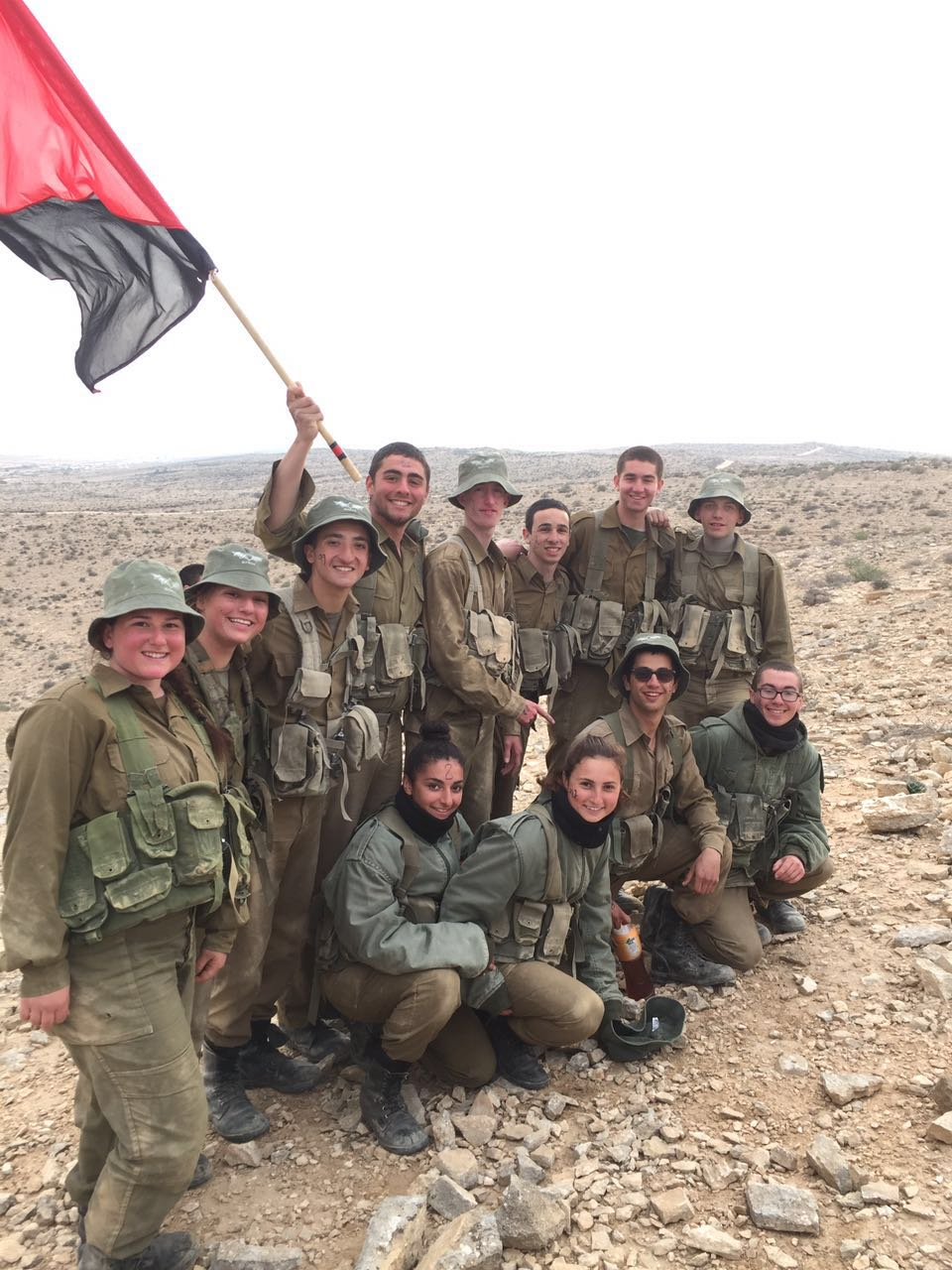
There was a lot of anxiety the week leading up to Marva- my friends and I had been told it was pretty hard. On your first day you go to the center for processing. You are in a room full of people you don’t know, there are commanders asking you questions and yelling at you- it’s shocking, a snap to reality, it puts you in the mindset that this is how it’s going to be for a while. After processing is done you get on a bus and head to your base, where you get new commanders who are new faces to you. They make you stand in a chet where you can’t move or talk for 4.5 hours before you are told which unit you will be in- after all that waiting you finally receive your uniform.  Putting on the uniform was a big relief. I received my rifle on the second day, and I had 48 hours to learn all the safety, rules, and components of the rifle. It’s a huge responsibility.

The first 2 weeks of Marva were the hardest because we weren’t allowed to go off base at all, we were always getting yelled at by our commanders, and you are trying to get to know everybody. The 3rd week was amazing because it was our shavua shetach (field week). We went camping, learned combat skills, and went to a firing range.

During South Week we went to Sderot which has one of the highest rocket attacks in all of Israel because it’s on the Gaza border. While we were walking through the town, people on the porches would stand up, wave to us, and call to us, “Chaim Sheli” and “Ani ohev otcha” (“my life” and “I love you”). It was an amazing experience seeing their faces light up, and we aren’t even real soldiers, we are just kids from around the world coming together to see what it’s like. That showed me that it does have meaning to people and wearing this uniform brings their spirit up. You don’t need to be an actual soldier to fight terror. Just by doing Marva we were fighting terror because it put a smile on people’s faces. That was a really amazing experience.

Making The Most Of Everyday Moments

Making The Most Of Everyday Moments

By: Rebecca Tauber, Recent Year Course Alumna

If you spot me wearing headphones on a bus ride to a tiyul or seminar, chances are I’m listening to a podcast. Israel Story is a show that seeks to tell the everyday stories of Israel. This idea is what kept coming to mind when reflecting on this year. I realized that the everyday elements are as impactful and important as the “headlines.”

The little things, aspects that only come from fully living in a community for an extended period of time, are what make our past nine months unique. I get a bit of a thrill navigating the bus system home without using moovit, or knowing when there will be traffic on the Ayalon, or picking out my favorite brands at the grocery store. Our Rav-Kavs and gym memberships and Malabiya punch cards are membership cards to Israeli society. I flash them with nonchalant pride, implicitly showing everyone, I live here. I will miss these small details of everyday routine  just as much as the bigger events. They turn this year from a collection of experiences into a lifestyle.

During the big holidays it is the small details of how Israel changes during these weeks that stand out. Eating in a sukkah at a restaurant, savoring the most intricate sufganiot for sale on every corner on Hanukkah, Israeli flags appearing everywhere on Yom HaAtzmaut, being out of place if you’re not in costume on Purim, the entire country seems engaged in celebration, and we get to take part.

Our volunteering provided further opportunities to integrate into Israeli society. Those of us who worked with Magen David Adom had the opportunity to enter an everyday Israeli workplace. We befriended members of the station, learned the lingo, and found our favorite food spots near all the hospitals. In committing to the work, we saw everything, both the good and the bad. Nothing was sugar-coated; one minute we would be driving down the Ayalon blasting Mesibah b’Haifa or getting bourekas from our favorite spot at Wolfson, the next we would be performing CPR or transporting someone with a stroke. Volunteering with Magen David Adom gave us a unique look into a marginalized part of Israeli society: elderly, sick, immigrants. A lot of the job was spent transporting old Russian people, so we spent our days going into tons of Bat Yam apartments, seeing, smelling, and hearing about how that part of our Bat Yam community lives. 

Those of us volunteering in Bat Yam engaged with the youth of our city, those on Marva experienced army life, those at Keturah braved the desert as kibutzniks, and those at Yemin Orde learned about and taught teenage immigrants. The small everyday aspects of these experiences will stick with us and truly make us feel a part of society. That moment when you run into volunteers from the MDA station around Bat Yam, or looking out the bus window and realizing that we have been in that apartment or park at 3am transporting someone. It could mean bumping into the kids you tutor while on the bus, or seeing your mefakedet in Tel Aviv or recognizing army terms during ceremonies or speeches. These tiny forgettable daily moments play a big part in creating a sense of belonging in our various communities. 

When I went home over break and visited friends from high school, I was constantly complimented on how cool my Instagram looks. Don’t get me wrong, I’m a pro at using those filters. And being told a Snapchat story is “lit” is one of the best compliments you can give someone of our generation. Yet while we all carefully curate our social media to boast beautiful hikes and crazy clubs and unique monuments, it is the small, everyday aspects of the year, those that don’t show up in a Facebook album or on a Snapchat story, that turn us from tourists to residents, and that turn Israel forever into a second home.  

My Year in Israel

My Year in Israel

10984287_10153184373549474_6582282671447642492_n

By  Year Course 14-15 participant, Sarah Silverstein 

Do the things you believe in. Because what we believe in makes up who we are. We often underestimate the extent to which the choices we make today affect us tomorrow. We don’t immediately realize how the people we meet and friends we make inspire and teach us. Conversations I have had this year, both inside the classroom and even more so outside it, have impacted my worldview.  They have strengthened some of my beliefs and challenged others.  That is one thing that Year Course, that choosing Year Course, did for me.

We know we’re growing but we usually can’t notice a difference until we have to look back in order to move forward. Picture yourself nine months ago and remember the fears you may have had about this year. Now, think about where you are at this moment. Do the fears you once had feel small? Do they feel far away? I can remember counting down the number of sleeps I had left in my room every night. I remember feeling like once I packed up and hit the road things would never be the same. Fast forward to now: I have learned that the feelings I had those nights weren’t so far off from the truth. One of the most difficult things that I have been fortunate to learn can be summed up by this quote ‘you will never be completely at home again, because part of your heart will always be elsewhere. That is the price you pay for the richness of loving and knowing people in more than one place.’ Over the past few weeks I’ve found myself counting the nights left here in Israel just as I had done nine months ago in New York. Fear is something inevitable within ourselves but sometimes the ideas and actions that scare us the most can lead us to our greatest accomplishments.

When I signed up for Year Course I didn’t know anyone else that was coming on the program.  I was a little worried about that but decided to make it a fun adventure.  It didn’t take much time to notice that many people already knew each other from Young Judaea. Introducing myself to a group of people who already know each other wasn’t so easy.  It felt awkward but everyone tried their best to say hi and meet everyone else.  About a month later, the dynamic of the group was changing. We were moving from strangers, to friends, to family. I think most of us would agree that the first impressions we had of each other began to fade away. The friend who had described themselves as shy was transforming into a social butterfly and the person who originally didn’t know where they stood on so many issues started screaming their ideas and opinions. So many of us have jumped out of our comfort levels, whether it be to help a friend or help ourselves, we have done it.  9 months ago I didn’t know who would bike the Kineret, who would hike the country, who would travel the world, who would challenge my opinions and who would agree with them, who would be lazy and who would be crazy, who would stop me from making mistakes and who would be my partners in crime when, inevitably, we all made mistakes. I didn’t know who I would be to each of you, or who you would be to me.  And now I gladly pay the price for the richness of loving and knowing people in more than one place.

I started by saying do the things you believe in, because when you believe in what you do you believe in yourself. You believe that even alone you can create, give, help and succeed. We are all, thank god, alive and capable of imaginable and unimaginable things. We are the only people who control our capabilities. If each of us can reflect on this year and say that we sucked the juice out of the fruit entirely, kol hakavod, don’t stop. Take Year Course with you as a reminder wherever you go that you not only tried, you succeeded.  For those of us who may feel like we didn’t get as much as we could have, start taking and giving and doing more. It is not too late to take the lessons of Year Course forward, to take matters into our own hands, to create meaning, to try something different and new, to repair the world, on whatever scale we can manage.  Take the recipes, the crazy stories, the almost accidents and new friendships with you wherever you go.

Year Course, for me, has been a year to figure out what I believe in and I’m sure this pursuit will follow me into my next chapter in life. Part of me hopes that this pursuit follows you too because life isn’t black and white and only we can decide how to color the pages.

My Year in Israel: Charlie Spiegel

My Year in Israel: Charlie Spiegel

485592_10203396357448411_473143495811261825_nThere’s this theory in quantum physics that our universe is just a small fraction of the entire cosmic picture; That the dimension we live in is just one of an infinite number of narratives that trace their way through the sands of time, each slightly different than the rest.  There is no limit to what these differences could be. It might be something huge, like all of us having seven toes, or something no one would ever notice, like water being a different shade of blue, but either way it leaves our reality changed. These changes, in turn, would lead to more divergent storylines, where sandal companies play a much larger role in global politics and Crayola has an entirely new subsection of blue crayons. This pattern will continue like the ripples of a pebble dropping into a stream; while initially faint, they create more and more of a reaction as time goes on. What I am here to tell you, my fellow year coursers, is that this is one of those moments, and that all of you are those blue crayons and seven-toed sandals that are going to make a difference in the world.

This world we live in, from the air we breathe to the mind-numbingly complex ways that our bodies interact with the world, is at our disposal. We are agents of change, the catalysts that will carry our world from one dimension to the next. We can create, we can destroy, we can live and we can hate and we can do anything we want, because we are capable and we are human. We have the strongest power in the world: the power to choose who we are and what we want to do. We have the power to physically change the reality we live in to make it a better place.

We chose to come on Year Course instead of going directly to college, and that changed the world.  Some of us might already be able to see how it has changed our individual worlds, but only time will show us how it has changed the entire world. Will it affect our educational choices?  Our career choices?  Or life choices?  This year in Israel, this Year Course experience?  The MDA course or going to Yemin Orde or falling in love with a person or a city or a beach or the entire country?  Every experience we chose to enjoy or ignore this year, it all changed us and shaped us into the Jews and Zionists and humans that we are right now, and it will keep on affecting us as we move forward, and that will affect the people we meet and so on, through the sands of time.

I understand this is a lot to take in, so even if only half of what I said resonated with you, I’m glad I could say anything to you at all.I hope each and every one of you appreciates that we are at this junction in our lives, isn’t afraid to embrace the moment, and strives to make as many ripples as they possibly can in this thing we call life.Things are going to be different when we get home, so we might as well hit the gates running.

Hatzer Kinneret: A Zionist Training Ground

Hatzer Kinneret: A Zionist Training Ground

By Year Course chanicha, Golda Adler

When we think of the holiest place in Israel our minds immediately shift to the Kotel, Tzfat, even Masada, but no one ever mentions Hatzer Kinneret- the place where the dream of settling the land of Israel became real life. Hatzer Kinneret, located in the north, was the home of the families and pioneers that came over in the Second Aliyah. Most of these families came over in hope of escaping the Kishner pogroms and in hope that Israel would be the nation state for the Jewish people. However, this wave of Aliyah planned on doing things a little differently than the First Aliyah. The families and pioneers that settled the Hatzer Kinneret looked up to A.D Gordon, who many call the “father of Labor Zionism”. Gordon encouraged the people to work the land themselves and make this a lifestyle. The community placed great emphasis on the beauty of the land, farming, and women in the work force; it was a new ideal that is still carried out today in Israel, but now is known as Kibbutzim. The families that lived in Hatzer Kinneret became so attached to the Kinneret, that they built the kinneret cemetery not to far from the courtyard. Here, many members of the Labor Zionism movement have been buried, among them Berl Katznelson, Moses Hess and Rachel Bluwstein. While up north, we took advantage of the beautiful sites and hiked and learned about the history of Har Arbel. Being up north and being in the very spot where the Labor Zionist movement began, made me realize the importance of the Second Aliyah and the lessons they practiced and instilled. A.D Grodon, the father of Labor Zionism, emphasized the practice of a person working the land with their OWN hands and praising the beauty of it, rather than hiring others to do it for you. He showed the pioneers that this practice not only built a community, but also allowed the Second Aliyah to find meaning and connection to the land, unlike the First Aliyah, which had others work the land for them. I got a taste of this beauty and appreciation for the land when we hiked Har Arbel. I got to overlook part of the north and climb down a rock wall and saw green as far as my eye could see. Visiting the Hatzer Kinneret and then going on a hike really allowed me to visualize why A.D Gordon and the Second Wave appreciated the land they had settled. While A.D Gordon and the Second Aliyah may have cultivated and given us the modern practice of kibbutzim, I feel that because it may not be so accessible for us Year Courses to harvest, or grow our own food, we can most certainly show our appreciation and expand our knowledge by going on more tours and hikes of mountains or kibbutzim. We should not only focus on the buildings and museums, but also explore and embody the beauty of Israel that inspired the Second Aliyah and spread this message with others.

A Poem From Rwanda

A Poem From Rwanda

By current Year Course participant, Eden Harir

So much has happened so fast.

I’m overwhelmed by the abundance of people,

Not by their numbers,

But by their warm genuine souls.

The tiny African children,

Who yell as we walk past, 

Muzungoo! Muzungoo!

Crowd all around us, grabbing our hands,

Smiling so proudly, 

Just because of our presence.

The Agahozo children,

Welcome us kindly

Eager to learn all about us,

And take care of all our needs.

They are so ambitious,

Yearning to learn,

Willing to work hard,

And upholding responsibility.

They understand the importance of loving yourself,

Confident in their bodies,

And comfortable with their peers.

Their affection is unconditional,

And spreads to all those they interact with.

Their dreams stretch far and wide.

They hold so much hope and optimism,

Guided by their aspiration

To make this world a better place.

Their beautiful rich voices,

Lost in a sea of song,

Ringing and bouncing of the hills,

Purify the fruitful land

That once shed blood and war.

They live each day with very little,

Remembering that some people have less.

Thankful for every grain of rice they consume,

And humble with their possessions. 

They remain loyal to their culture,

Submerged in song and dance.

Talent flowing out of them,

And connecting them to their past.

They are each other’s support system,

Casually reciting inspirational quotes.

Treating Agahozo as their home,

And each other as brothers and sisters.

Despite their difficult backgrounds,

They are among the happiest of people.

Their spirit so uplifting,

And energy that emulates warmth.

Their passion is endless,

More honest and virtuous than anyone I know.

I can see the bright road ahead of them,

Guiding them to their immaculate futures.

Everyday I wonder more and more,

Why am I here?

They have everything they need right here.

And are clearly thriving off the opportunities they’ve been given.

What values can I possibly offer,

That they don’t already embrace?

These kids are brighter, happier, smarter

Than I will ever be.

And I am utterly overwhelmed.

They’ve taught me many things,

Through who they are.

I have no right to complain.

No right to be lazy.

No right to have spite.

And no reason to feel sorry for myself.

I came here thinking,

I could help them to succeed.

But instead they’ve helped me.

Their existence will remind me,

Everyday of my life,

Of the type of person I wish to be.

The First Few Days in Rwanda

The First Few Days in Rwanda

By Year Course participant, Hannah Solomon

After two tiring plane rides, and a five hour layover in Ethiopia, our group finally landed in Rwanda. We were all exhausted, but ready to dive headfirst into the three weeks that lay ahead. Stepping out of the airport, we were immediately greeted by the overwhelmingly beautiful scene of the green landscape filling Rwanda. It was extremely refreshing compared to the arid Middle Eastern climate we were all used to, but the blaring heat was just as bad. A small day trip through Kigali opened our eyes up to a completely new and exciting culture (we sampled a “Rwandan Chipotle”). The streets are busy, and buildings fill the skyline, showing glimpses of the rolling hills just beyond the horizon. Kigali bustles with a strong variety of people. Motorbike taxis zoom past, children walk to and from school pushing through the groups of adults, and some women carry themselves tall, while balancing belongings on their heads. Even the local shopping center was packed with souvenirs special to Rwandan culture. We all piled into our minibus, and settled in for the hour long journey to the Agahozo-Shalom Youth Village. As we drove, the scenery gradually changed from metropolitan men and women in their city, to children walking along the dirt road, with large mountain cliffs showcasing the countryside. Small clay houses stood at the ends of dirt paths, with families waving to us muzungus. We arrived at the village on Monday afternoon, and were warmly greeted by many smiling faces, handshakes and conversation.
The overwhelming day past quickly, and on Tuesday we were thrown right into volunteering, following a 6AM breakfast consisting of maize porridge, Rwandan tea, and one sweet roll. The 11 of us joined the Senior-4 class for their tikkun olam project, taking place in the neighboring village of Rubona. We left the village and walked along a dirt road, not really knowing what to expect. The kids walked in one large group, together in a general mix of excitement. I began a conversation with a few kids, and they told me what “tikkun olam” truly was. They educated me as if I had never heard of the Hebrew phrase before, and were so passionate about every word. These kids are filled with positive attitude, intelligence, and motivation aimed towards themselves and the world that is so strong and unique. I learned about how, in order to achieve tikkun olam, you must first do tikkun ha’alev. Repairing and mending your broken heart is the first step to repairing the world. I was very inspired by their words, but was still not entirely sure what we were doing…
We arrived to a small mud house, and walked far behind it, down a hill to a small clearing. The kids started overturning the dirt and laughing at each other in Kinyarwandan. They brought down jerry-cans full of water and poured it onto the dirt. Five barefoot girls sprung up and began stomping on the water, making mud. Wanting to get in on the action, we all quickly unlaced our shoes and took off our socks, diving feet-first into the mud piles. After making all that mud, we saw the boys and girls taking chunks of mud back up to the house. I
grabbed a pile of mud and made my way to the top of the hill, following in step with our bare and muddy feet. I walked into a scene filled with goats, chickens, and the kids throwing mud at the walls of this house! The project was re-surfacing this small house with a new layer. An assembly line began to form, and I took my position by the house, throwing small chunks of mud against the house, and smoothing it out. We all joined together, singing, laughing, dancing and occasionally hitting each other in the face with mud. Mud was splattering everywhere, and I was definitely the target of more than one mud-pie. We worked for an hour, and the progress was visible. Almost the entirety of the house was covered. The owner was a thin old man, sporting a cane, who had been watching us work the whole time. On my way out, I shook his hand and said, “nishimiye kuba menya,” (nice to meet you) showcasing my newly-learned Kinyarwandan skills, which had taken me almost the whole hour of working to learn. Even though it took me so long to learn, the kids never stopped trying to teach me. “Try and fail, but never fail to try” was the motto that almost ten different kids told me that day– on separate occasions. It was so eye-opening to be able to see the kids of the village use their resources to help anyone they can. I’m glad I got to be a part of it.
The tiring walk back to the village, caked in mud at the end of the day was definitely worth it.