Branching Out

Branching Out

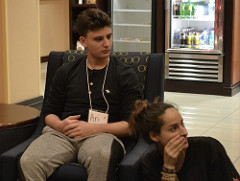
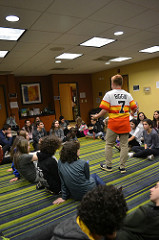
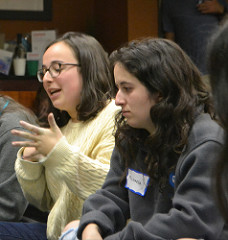
Adina (l) makes her point

As an active member in Young Judaea, I’m incredibly passionate about our programming. We write, lead, and participate in great peulot and educational activities. Today we participated in an educational activity lead by the Transformative Teaching Collective. This cooperative promotes social justice based education in South Carolina. Naturally, I was skeptical at the idea that another group from outside of YJ would come and lead programming for us. But to my surprise, something about these new activities felt innovative and special. The structure of the programming was similar to how we write our peulot. I had even personally discussed many of these topics before. So, what was different? Why was I so captivated by these lessons?

It wasn’t until the latter part of the activity that I began to understand the root of my appreciation. We were able to confront hard conversations with people who were different than us, people outside of our movement. I often find myself discussing complex topics with my close communities. In these communities, these places where I feel a deep sense of belonging, I feel comfortable speaking because I know my opinions are welcomed. But, here when we branched out we didn’t have to draw lines between our differences, we built bridges. This created a safe space where many individuals felt comfortable sharing their opinions.

I love witnessing educational programming, especially programming this engaging. I hope to be able to emulate what I saw today in our activities for other peulot. If we increase the diversity of the opinions we hear in Young Judaea, we can continue to push the limits of our knowledge. I’m excited for what will come of this challenging, stimulating, ongoing discussion.

~ Adina Ornstein-Luks; 12th grade – Chapel Hill, North Carolina
It’s Worth the Struggle

It’s Worth the Struggle

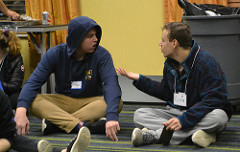
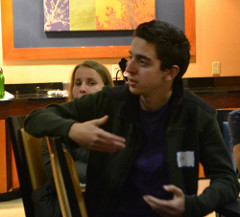
Ben debriefs with his peers

This is my third time on AWB, and this trip has stood out to me in particular. Why? It’s because we dove into the heart of one of society’s pressing issues, one that questions an ideology that Americans have struggled with for over 200 years. . . racism.

The educational programs have gotten me to think a lot more about different American social policies. I’ve obtained a greater understanding of what makes a person who they are can be either beneficial or detrimental in society. This has me thinking about a program that was done at Camp Sprout Lake where we made it a mission to combat all forms of hatred. At the end of the program, all campers and staff went up to a poster with the word “hatred” written in English and Hebrew and put down post-its of ways they were going to fight hatred in the world. Fighting hatred is always a good thing, but at the same time I reached a conflict: how do we fight hatred in America when hateful speech is protected by our freedom of speech. Fighting hate in America is incredibly difficult because our constitutional rights protect all Americans in public and in the privacy of our homes, including Americans with hateful ideologies. Finding ways to end hatred in America can prove difficult because it can affect freedom of speech and expression for all Americans, but that doesn’t mean it isn’t worth the struggle.

A few months ago I was awarded the Milly Kubrick Youth Service Award. It is an award given to high school seniors every year by Westchester County recognizing them for their devotion community service. I owe a great deal of my achievement to Alternative Winter Break. This may be my last time participating in the program, but I hope to come back soon and continue devoting my winter breaks to making the world a better place.

~ Ben Gotian; 12th grade, New Rochelle, New York

Simple and Blunt Intentions

Simple and Blunt Intentions

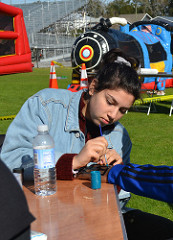
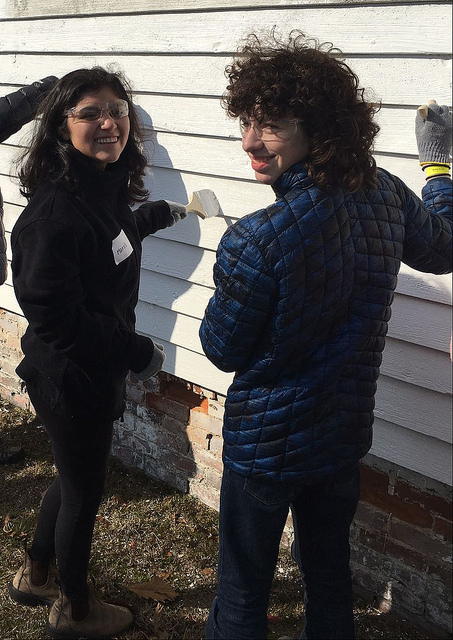
Nava hard at work

Today AWB volunteered at a Christmas Party for underprivileged families, with the hope of providing gifts, haircuts, and some holiday cheer to them. Most of the students were working with children in the carnival area of the ‘Birthday Party for Jesus’. I chose to work with kids at the Face Painting station.

Overall, the experience was one of joyousness and fulfillment. It always strokes a portion of a person’s ego to help another, but when it has meaning, the time spent can be transformative to all involved. While reflecting on the day, a specific interaction that I had with a little girl named Rashida stuck with me.

Rashida, accompanied by her mother, had been waiting in line for the bouncy castle for 15 minutes. Rashida began to cry when the line didn’t seem to be moving. Her mother silenced 7 year old Rashida and disciplined her tears. This act, unsurprisingly, upset the child more. Rashida ran away from this painful interaction, for a moment, before stopping to collect herself and calmly ask her mom for permission to get her face painted. Permission was granted. And she came over to me.

Rashida walked over with fierce excitement and a tinge of understandable sadness. When she sat down, her mother left. I was relieved that the negative energy walked away with Rashida’s mom.

I began to tell Rashida, while painting a sparkly butterfly on her hand, that I cry often. She asked if I get in trouble for it. I replied by saying sometimes crying can help the situation and sometimes it can poorly affect it. The difference lies with the action we take after we collect ourselves.

I told Rashida that I was impressed at how calmly she asked to get her face painted. Her face lit up. “Sometimes I cry and I can’t stop crying but I didn’t want to cry today because it’s Christmas,” she commented quietly. We sat in silence for a moment as I finished the less-than-awesome animal on her hand.

“What’s your name?” She asked. “It’s Nava. I replied.” She leaned in to give me a hug.

This interaction is one of great meaning to me. Ironically, going into service for me can sometimes feel selfish. Am I doing more this more to feel okay about myself? Or am I doing it with the simple and blunt intention to give to others?

After I saw the unsettling situation between Rashida and her mom, I had the intention of connecting with her. I related to her discomfort and anxiety. And when she sat down on the seat in front of me, it felt like fate had willed us to talk.

I think service become transformative and beautiful when givers come in with a purpose. Rather than have the desire simply to ‘give’; entering a space of giving with a specific and focused desire. Sharing a part of me with Rashida felt like that specific desire, and through that vulnerability, I became deeply fulfilled by this small interaction I had today.

~ Nava Schorsch; 11th grade, Bronx, NY


Feliz Navidad

Feliz Navidad

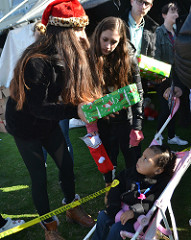
Tamar distributes gifts at the Without Walls Party

I had many different experiences and emotions throughout the day after being chosen  to be a translator for Spanish speakers at the gift-giving station at the Without Walls Christmas Party.  At varying points in the day, I felt: happy, fulfilling and grateful, while at other times I felt frustrated and shocked. I heard a number of racist comments towards the guests that left me very unsettled. 

While at the station, some of the volunteers pointed out certain individuals because of the way they dressed or portrayed themselves. The volunteers reminded us to keep an eye on them and make sure they weren’t stealing. I was uncomfortable listening to the volunteers make assumptions and comments because of the way the guests looked. I noticed that most of the guests were people of color. This highlighted the systemic and institutional racial problems that our society faces at this moment in time. A comment that made me particularly upset was “Watch out for that man. He’s a Crackhead.” This opened my eyes to the inequalities that people of color may face daily.

Although there were negative and uncomfortable situations throughout the day, it was mostly filled with positive, uplifting, and grateful vibes. The racially insensitive comment that the volunteer made really stuck with me. I feel motivated to take action and have productive discussions throughout the rest of the week about racism and social injustices. I was grateful to be able to give these kids the opportunity to receive a present that they may have not gotten if it wasn’t for this incredible event.

~ Tamar Yaari; 11th grade, East Northport, New York

Sports is a Place of Community

Sports is a Place of Community

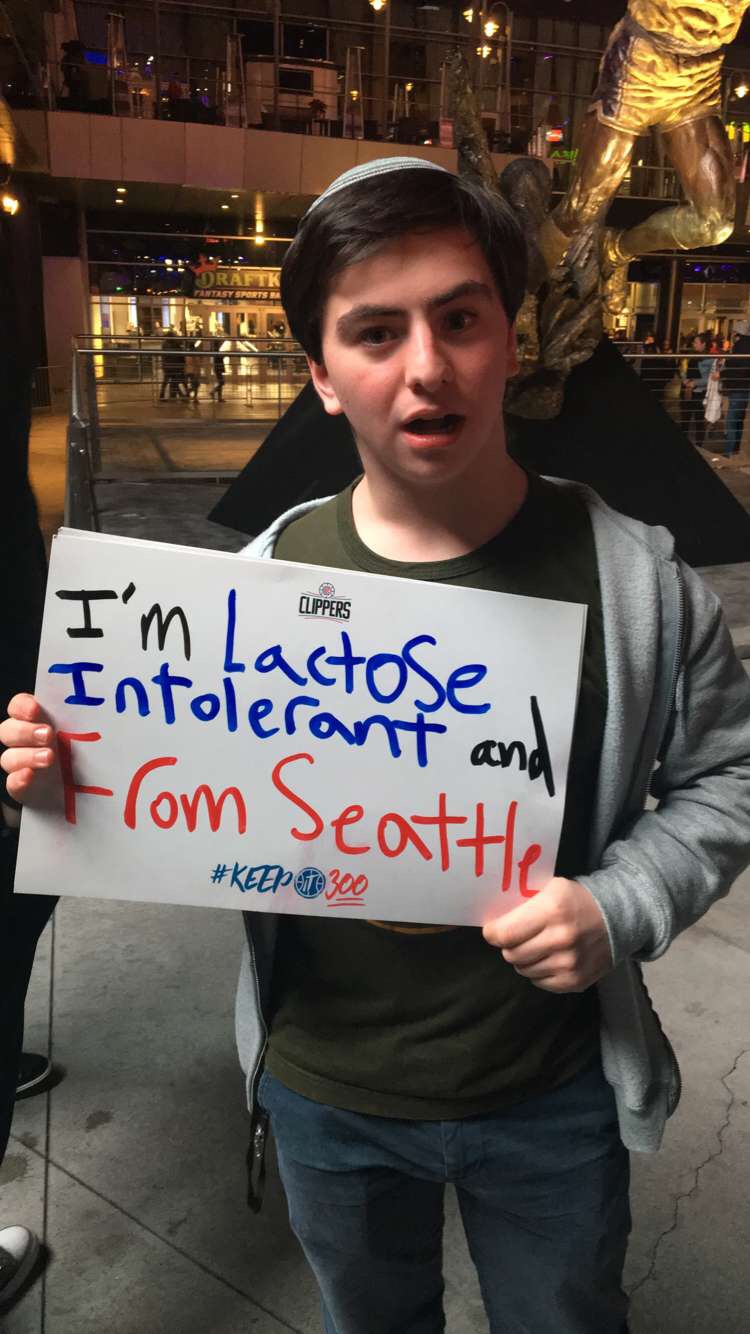
Ari Reflects on the Day

Today, the first full day of the 2017 AWB trip to Charleston, we volunteered at a party open to anyone inside the community who wished to come. This party was run by an organization called Without Walls. This is a Christian based organization that holds this event every year for Christmas. At the event, volunteers give out presents to kids in need and some general necessities such as: blankets, pillows, and just anything that someone who can’t maybe afford could use. Since the event took place on a football field, it seemed natural to also play football. This is where my experience takes place.

Personally, I felt uncomfortable with the power dynamic involved in giving out presents. This is why I chose to do my service on the playing field. Sports is a place of community. When you are on the field, no one cares about the color of your skin or what culture you were brought up with. Instead, the focus is strictly based on how to stop the opponent in front of you. The sports field is the one of the few places in the world where everyone is on the same playing field.

Before I went to the carnival, I never could have imagined the connection that can be made just by throwing a ball to a stranger. After a couple of passes to each other, we made two randomly selected teams to play a football game. It was amazing how good of a time we were all having. It was crazy how much of a bond you can create with people that you just met.

At this event,  I learned that the best present you can give to someone is just a good time. The people that were playing on that football field seemed so happy and carefree. This experience that I had today is something that I will take with me forever.

~ Ari Kantorowitz; 10th grade, Jericho, New York

Two Very Different Experiences

Two Very Different Experiences

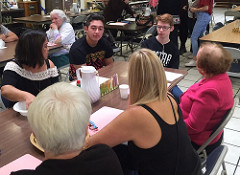
Ezra (r) Debates

This morning, AWB split up and ventured to three different volunteer locations, followed by a tour of an historic slave plantation in the afternoon with all of AWB. My group went to the Sherman House, a subsidized independent living facility for seniors. A friend of mine and I were paired with a lady who was probably in her early seventies, and still seemed to be very much with it. We helped her with household chores in her apartment, mainly tasks that she’s unable to do on her own. Although we found the physical tasks extremely rewarding and fulfilling, I personally found the substantive conversation that we had to have the biggest impact. We mainly discussed politics and Judaism, really connecting on both and intellectual and personal level. Rather than feeling like I was talking to her to just be nice, I found myself really enjoying our time together, and I felt as if she could have been my own grandmother by the end. We dove into the complexities of American and Israeli politics, gossiped about the various other old ladies in the facility, conversed about her children and grandchildren and our own families, discussed the history of the U.S. Constitution, and learned about her rescued cat. Yet one of the highlights of that activity wasn’t even with her. What I enjoyed most was when she took me to meet her 92-year-old neighbor who, at my age, had been on the run from the pogroms in her Ukrainian shtetl, and to taste her strudel. I just found her stories remarkable. It was hard for me to imagine everything that she had been through, even when she was younger than I am today.

The plantation, on the other hand, provided a much different experience. This was a much more informative activity, in which the tour guide brought us through what it was like on a South Carolina plantation in the Antebellum South. We learned about the slave conditions, the life of the masters, and even the different crops that were grown. What he really emphasized, though, was how the antebellum system has contributed to what racism is even today. He described it as a linear path, an idea which was interesting, but was also challenged by some of us. We really took a lot out of that tour. We learned the history of the plantation and systems of the time, but we also learned about and discussed the much longer lasting implications these facts, ideas met with both consensus and disagreement.

~ Ezra Meyer; 12th grade, Chevy Chase, Maryland

Staff Reflection: Nathan Rubinger

Staff Reflection: Nathan Rubinger

Nathan (standing) Educates

My biggest regret as Young Judaean is not attending Alternative Winter Break when I was in Young Judaea. However, being able to see the work our teens are doing this week surely makes up for it. On the second full day of our program the teens  split up to head to different volunteer opportunities. Our first group went to East Cooper Community outreach where they spent their time sorting clothing, shoes, and other supplies for those in need. Our second group landed at Eagle Harbor Ranch where they had the opportunity to work with kids who  come from backgrounds where they were either orphaned, abused, and/or abandoned. Last but not least our third group went to The Sherman house, which is assisted independent living for the elderly community run by the Jewish Federation of Charleston. There they spent their time with residents helping them clean their apartments. While our options all seem very different all of our teens spent their days in some ways helping others who might not be able to help themselves.

Our second half of the day was just as if not more emotionally intense.  Following our morning activities, our participants had the chance to explore the history of slavery at Mcleod Plantation. Paul, our tour guide, did a wonderful job of leading an insightful discussion of how the affects of slavery are still seen today and why things have and haven’t changed. The night continued with a activity run by an organization called the Transformative Teaching Collective. The two hours were spent discussing how our different social identities are perceived by ourselves and others and the role that race plays in our personal lives. On a personal level, as a Jewish educator who grew up in South Carolina, it is really inspiring to see our teens spending their time helping others and tackling incredibly difficult issues.

Nathan is Young Judaea’s Senior Advisor and National Program Coordinator

An Exploration of the Plantation past and Perspective filled future

An Exploration of the Plantation past and Perspective filled future

Raviv Interacts with Paul at Mcleod Plantation

This is my first experience in the South, a completely different atmosphere and historically filled past than my native Seattle, Washington. So going to a plantation brought my dreams from US history class, of visiting American historical landmarks, to fruition. We walked through the McLeod plantation led by our knowledgeable tour guide, Paul. We learned about the slaves who worked the cotton, corn, hay, and other crops on the 37 acres of property. I found inspiration from each word that Paul said. He took us from place to place sharing about how bricks were made, lives were impacted, and dreams were crushed. Furthermore, he took my experience further when he took one of my madrichim (counselors) and me to the recently planted cotton field and talked to us about what the plantation teaches us. He spoke on the unbroken line he found from slavery to now of institutional incarceration and voter suppression. This drew a line for me between the present and the past, Paul gave me the needed call to action and recognition that the past is repeating itself, that we need to work harder to create a broken link.

This is the purpose of Young Judaea’s Alternative Winter Break; it gives us opportunity to find injustice and gives us the tools to approach it.

The tools that we are given to explore injustice are created in Peulot (Activities), and this particular peulah came from an outside organization. The Transformative Teaching Collective is a group of individuals that give education social justice talks to groups. In our session, we discussed social identity and its effect on how we perceive the world. In the other part of the programming, we experienced a social barometer, a method often used in Young Judaea, where we were given statements and stood in a corner of the room that described how much we agreed or disagreed with the statement. I pulled inspiration from the perspectives that we discussed with the barometer, seeing how different members of our movement and other outside community members experience race. Each time I heard a new person talk I had an opinion on what they said and found myself finding their justifications relevant and valid. The moment that stood out to me was when we discussed the statement on: People of color self-segregate and therefore don’t allow diversification and continues the racism in the country. I heard different people give their perspectives on how their reality is shaped by race. I responded with an idea about how I don’t fully agree with the statement because America is focused on assimilation and how that isn’t always the answer. I learned the value of perspective and the activity gave me the tools to take back to my community.

~ Raviv Cohen; 12th grade, Sammamish, Washington

More than Just a Day of Cleaning

More than Just a Day of Cleaning

Evan (l) makes someone really happy

Today, at the Sherman House, an independent living residence, we were tasked with helping the residents clean their apartments, but our purpose there went deeper than that. It seemed at first as if the woman I was helping didn’t need my assistance, but after talking to her for a few minutes, I realized that I was really there to be with her and connect with her. I learned that she grew up in Charleston, was involved with the hippie movement, adopted her daughter from China and unfortunately separated from her husband soon after.  She moved in to the Sherman House a few years prior, had attended a Christmas party the day before I had met her, and suffered physically from arthritis flare-ups that prohibit her from doing the things she loved. Sadly, as she showed me around her unit and told me about some photos and objects there, I learned about the hardships of losing friends and the constant reminder of them that remains in one’s everyday life. I realized that today’s service wasn’t necessarily about cleaning apartments, but rather about being open and available to talk to someone who may not have the opportunity to interact and engage with others as often as one might need.

Later at the hotel, a group called the Transformative Teaching Collective led an activity focused on identifying aspects of one’s social identity and opening up about racial issues and injustices in one’s life. From the start they set a comfortable atmosphere by instructing us to be vulnerable and open about ourselves. I found it very easy to share my experiences and opinions and even form and modify my own opinions based on insight I had gained from hearing others speak. The facilitators ended the session by reminding us that New Year’s was coming up and asked how we want to face ourselves and social justice differently in the New Year. I shared that I wanted to keep in mind that when interacting with others, people should always remember that they don’t know someone’s complete backstory. From there, one should be aware of how and what they say to others and to treat everyone with the respect they deserve.

 ~ Evan Ressel; 11th grade, Plainview, New York

Transformative Teaching Collective

Transformative Teaching Collective

Marili (l) volunteering with Home Works USA on AWB.

This evening we participated in a social action workshop led by members of the Transformative Teaching Collective. This organization encourages people to explore their social identities through group activities and discussions. Within  these discussions, we were able to  share our experiences, thoughts, and opinions on the subject of racism and oppression. The conversation itself was fascinating to witness in the sense that although we are a fairly homogeneous group (in terms of race, class, religion), each person had their own unique background which helped establish their relationship with diversity. The beauty of this workshop lies in the ability of the participants to share their experiences and explore the discomfort, curiosity, or emotions the they evoke and to then utilize them as educational tools. Thus creating a new form of intellectual power from their vulnerability.

~ Marili Ressel; 12th Grade, Plainview, New York