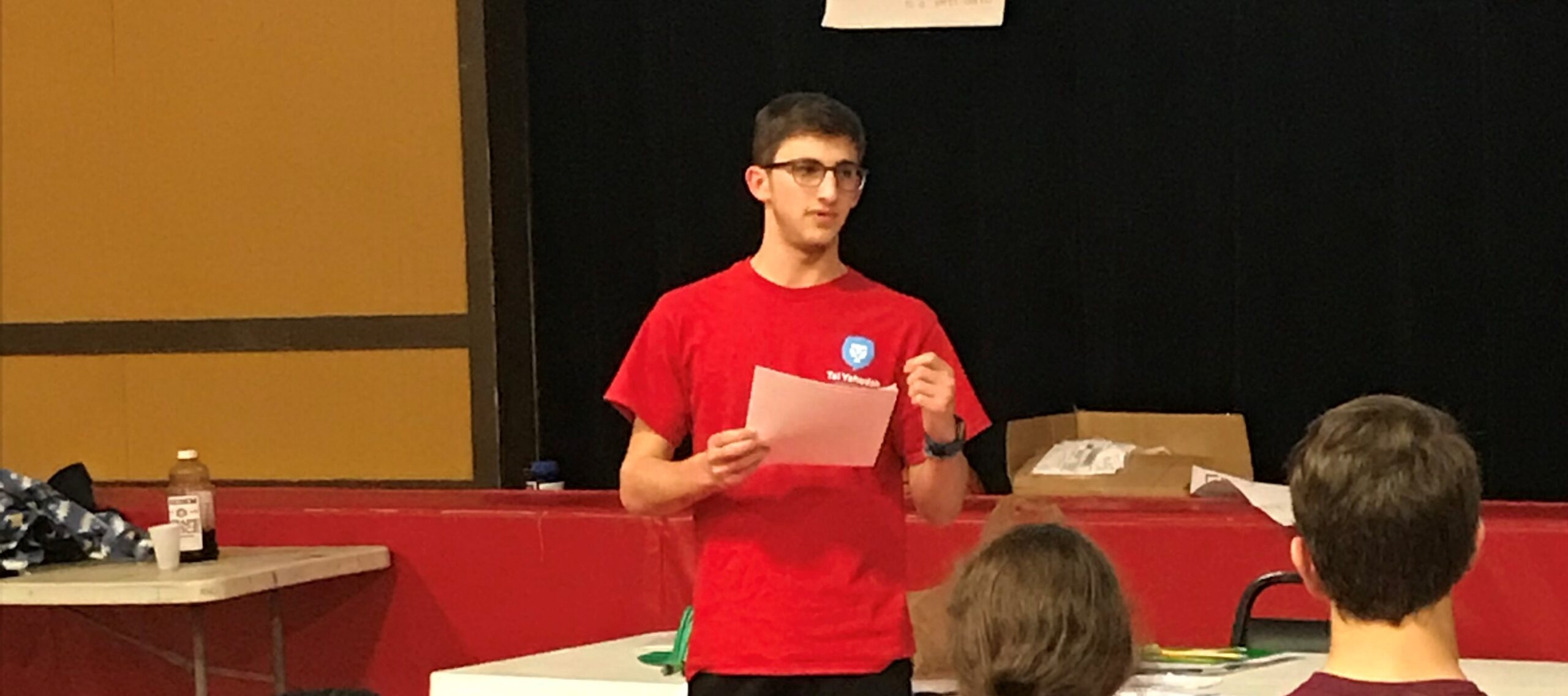
Erev Tov.
To start, I want to welcome you all to asepha. Asepha is one of the most important parts of national convention and of what we do as a peer-led youth movement. It is our chance to shape our future and examine what’s important to us as a Pluralistic Zionist Youth movement.
But why are you here? Think about it. What has driven you to spend a weekend around other Jews learning about cultivating a community? I’m sure that for many of you the primary answer to that question is simple. Your friends. The connections you make at summer camp and through involvement in Jewish youth movements are unlike any other relationship. Aside from these connections, Jewish youth groups and youth movements play an incredibly important role. They bring together Jews, who as a people that for thousands of years have survived the pressures that try to force us apart. Simply, Jewish youth movements keep Jews Jewish. There is still undeniable antisemitism in this world, and if we as a people desire to overcome it, it is imperative that teens have the means to explore and foster their connections to Israel and Judaism.
I’d like to share a few statistics from a survey of Young Judaea alumni published last year.
- Over 80% of respondents indicated that Young Judaea has had a strong influence on their relationship with Israel, their Jewish identity, and on their view of the world
- 92% of young adult YJ alumni are either very or somewhat emotionally attached to Israel
- 74% of young adult YJ alumni say being Jewish is very important,
- And almost 75% of Young Judaea alumni have sent or plan to send their children to Jewish camp, almost 50% to YJ camps
It is clear that for these alumni, their involvement with Young Judaea and Israel as teens has shaped their lives and kept their Judaism and Zionism alive.
Clearly, being involved in a youth movement is important, but all of you are here. There are over a dozen other Jewish youth groups and movements in the United States, but you chose Young Judaea. What is so special about OUR movement?
Well, we have a deep-rooted history. We are the oldest Zionist youth movement in America, and I’m pleased to share that on June 10th, Young Judaea will celebrate its 110th birthday.
From the start, Young Judaea has been at the forefront of Zionist and Social action. In 1909 we were a collection of Zionist clubs across the country, and many of our chanichim made aliyah to lay the groundwork for the future Jewish state. We had a presence at the March on Washington in 1963 during the Civil Rights Movement, were active in the Soviet Jewry Movement, every winter we give our time and energy to help struggling communities, and we even created our own kibbutz.
Today, we still challenge Jewish teens to think critically about Israel and Zionist ideas. By cultivating a pluralistic environment, we’ve developed a strong commitment to openness and diversity of opinion, and have emphasized a tradition of acceptance in our chanichim. It is important that we keep this going and continue to encourage teens to engage with Israel. We focus a lot on the polarization of American politics and our communities here, but as a Zionist organization, Israel is in our roots. One can even argue that the situation in Israel is becoming just as polarized as the U.S. My hope for Young Judaea and all of us is that YJ will be the place for us to struggle with our Zionism; that YJ will be the place for teens to find and use their voice to fight for what is important to them.
I’m sure we can sit here together and talk about what Young Judaea means to us for hours, but instead, I want to turn to what YJ has done just doing this past 5 and a half months.
- Although we don’t have an exact number yet, more kids have already participated in local programs than in recent years.
- New groups of teens have come together in Atlanta, South Florida, Los Angeles, and New England to revive their regions and engage teens year-round.
- Established clubs such as Pittsburgh and Flemington have grown stronger than ever
- The Midwest region had its largest winter convention and look forward to an even larger one in the spring.
- In the Northeast: LINYC, Empire, and New Jersey continue to have regular events, and Northeast Convention has also been larger than ever.
- And As we speak, Puerto Rico Young Judaea is having its annual kibbutz weekend
It is clear that Young Judaea is doing well and is looking at it’s second or even third year in a row of a sustained increase in participation.
I want to end by reminding you that Year-Round Young Judaea is only one part of what YJ’s executive director Simon Klarfeld calls “the Young Judaea ecosystem.” This includes not only Year Round Young Judaea but also the five YJ camps and our Israel programs. Our summer camps are especially important in the development of passionate and confident teens that give life to year-round programming. The two form a cycle, feeding each other and helping the entire ecosystem grow. Participating in year-round programs helps to develop strong leaders who can then walk into camp with confidence in their leadership and a passion for the movement, which in turn inspires others to join, creating a positive feedback loop that fuels the movement that we love.
If we want to continue the upward trend I mentioned earlier; if we want to continue to grow our already active areas and expand Young Judaea to new areas, it has to come from us. Look around; we are the future of Young Judaea: the kids, the leaders, the passionate and inspired teens that want to be connected to each other, Judaism, and Israel.
I hope you keep these things in mind during asepha both tonight and tomorrow night, and throughout the rest of the weekend.
Todah.